# How to Create a Gym Workout Plan for Beginners: 7 Steps and a Sample Week
> How to plan a gym workout as a beginner: pick your days, choose exercises by movement, set reps and rest, add weight safely, and follow a sample week you can start now.
- Published: 2026-11-25
- Updated: 2026-11-25
- Author: FitDrake Team
- Tags: workout plans, strength training, progressive overload
- Canonical: https://fitdrake.com/blog/how-to-create-a-gym-workout-plan-for-beginners/
To plan a gym workout as a beginner, pick one goal, choose 2 to 3 non-consecutive days, and build each session from five movement patterns: squat, hinge, push, pull and core. Do 2 to 3 sets of 8 to 12 reps with a few reps left in reserve, and add weight in small steps once you hit the top of your rep range. The days and rep ranges below are consistent with CDC and American College of Sports Medicine (ACSM) guidance, and a sample week and a fill-in template follow.
Written by FitDrake Team, updated on November 25, 2026
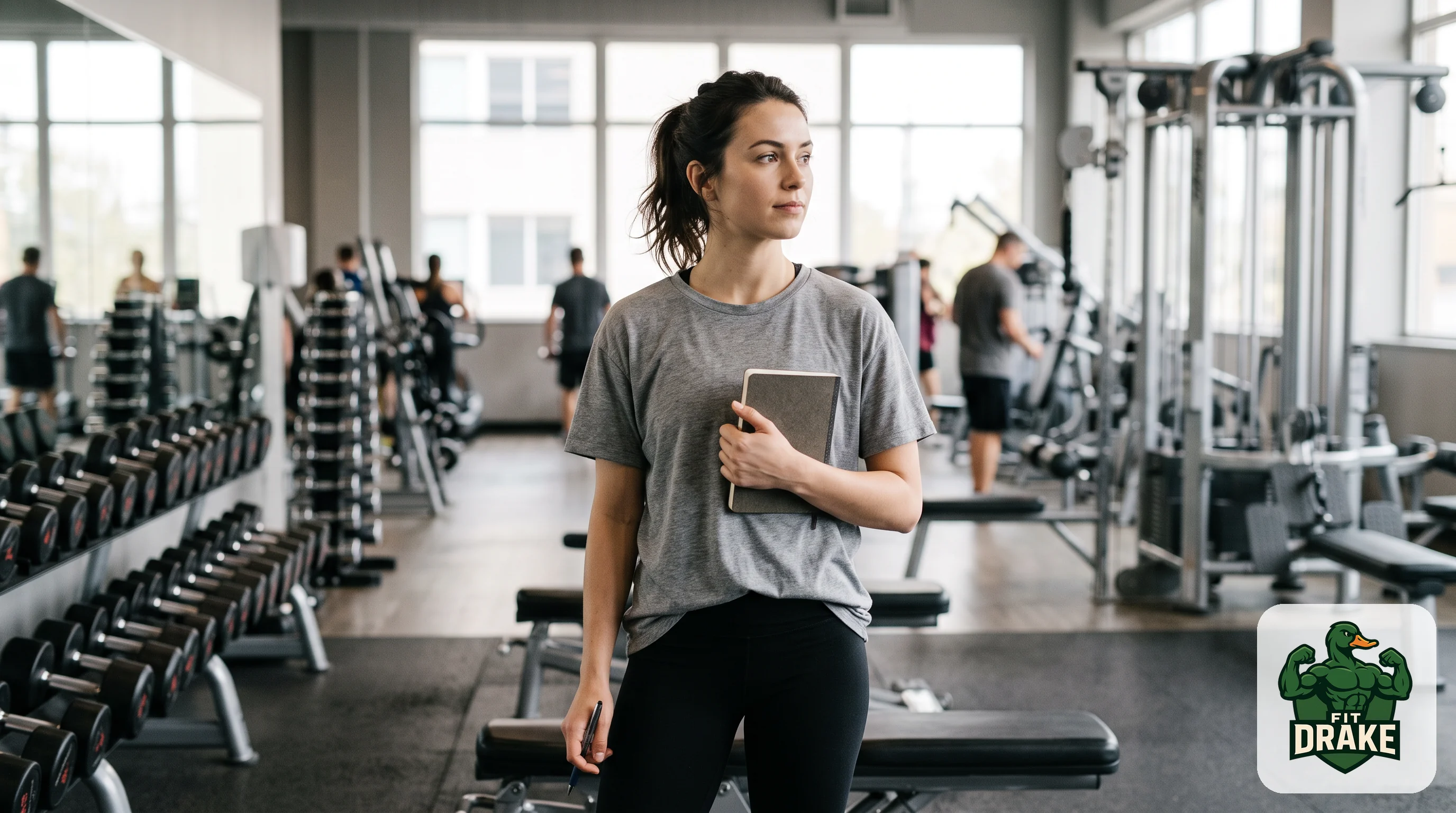
Walking into a gym with no plan is the quickest way to feel lost. The machines look complicated, everyone else seems to know what they're doing, and it's easy to wander from one thing to the next. A simple written plan fixes that, and you don't need a perfect one. You need one you can repeat.
This guide walks through the plan step by step: your goal, how many days, which structure, which exercises, how many sets and reps, how heavy to go, and how to progress. You'll also get a sample week with a machine option and a free-weight option for every movement, a 4-week example of how the numbers move, and a fill-in template so you can build your own routine.
## Why should a beginner follow a written plan at the gym?
A written plan removes the daily guessing, so you spend your energy lifting instead of deciding. Without a plan, most beginners drift toward the exercises they already know, skip the ones that feel awkward, and never repeat a workout closely enough to see whether they're getting stronger.
A plan does three things. It makes sure every major muscle group gets trained. It gives you the same workout to repeat, which is the only way to measure progress. And it makes it easier to show up, because you already know what you're doing when you walk in. The plan doesn't have to be clever. It has to be specific enough that you could hand it to a friend and they'd know exactly what to do.
## How do you plan a gym workout in 7 steps?
You plan a gym workout by making seven decisions in order, then writing them down. Here's the whole method on one page, and the sections below explain each step.
1. Pick one main goal.
2. Choose how many days a week you'll train, and schedule rest days.
3. Choose a structure, which for most beginners is full body.
4. Choose exercises by movement pattern: squat, hinge, push, pull and core.
5. Set your sets, reps and rest.
6. Pick a starting weight using effort, not ego.
7. Decide how you'll progress, and track every session.
## What goal should a beginner pick?
Pick one main goal for the first 8 to 12 weeks: build muscle, get stronger, lose fat, or build a general fitness habit. They overlap more than they conflict, because all four start with the same thing, which is regular full-body strength training that gets a bit harder over time.
The goal mainly changes the details around the training. If you want to build muscle, you'll push your sets closer to your limit and pay attention to eating enough. If you want to get stronger, you'll care more about adding weight to the main lifts. If you want to lose fat, food choices do most of the work, and lifting helps you keep muscle while you do it. If you just want a habit, the goal is simply to complete your planned sessions each week. None of these promise a particular result in a particular time, and that's fine. A clear goal is a direction, not a deadline.
## How many days a week should you go to the gym?
For most beginners, 2 to 3 days a week is the right range. The CDC recommends that adults do muscle-strengthening activity on at least 2 days a week, working all the major muscle groups, according to its [adult activity guidelines](https://www.cdc.gov/physical-activity-basics/guidelines/adults.html). The ACSM's position stand on [resistance training progression](https://pubmed.ncbi.nlm.nih.gov/19204579/) recommends 2 to 3 days a week for novice lifters.
Space your sessions so you have a rest day between them, for example Monday, Wednesday and Friday, or Tuesday, Thursday and Saturday. Start with the number of days you can keep up for months, not the number that sounds impressive. Two sessions you actually do beat four you abandon in week three. You can always add a day later.
## Should beginners do full body or a split?
Most beginners should do full-body workouts on 2 to 3 non-consecutive days. A full-body session trains every major muscle group each time, so with 3 sessions a week every muscle gets trained 3 times. A "chest day, back day, leg day" split usually trains each muscle once a week unless you go 5 or more days, which is a lot for someone just starting.
A meta-analysis of [training frequency and muscle growth](https://pubmed.ncbi.nlm.nih.gov/27102172/) concluded that training each major muscle group at least twice a week looked better than once a week when total volume was equal. Full body makes that easy, even on a 2-day schedule.
If you outgrow 3 full-body days, the usual next step is a 4-day upper/lower split, which still hits each muscle twice a week. You don't need that yet.
## How do you choose exercises for a gym workout plan?
Choose exercises by movement pattern, not by muscle name. Every full-body session should include one squat, one hinge, one push, one pull and one core or carry exercise. That covers the whole body with five choices, and it gives you a simple rule for swapping anything that's busy or doesn't suit you.
Here's what each pattern means, with a machine option and a free-weight option for each:
| Pattern | What it trains | Machine option | Free-weight option |
|---|---|---|---|
| Squat | Quads, glutes | Leg press | Goblet squat |
| Hinge | Hamstrings, glutes, lower back | Seated or lying leg curl | Dumbbell Romanian deadlift |
| Push | Chest, shoulders, triceps | Chest press machine | Dumbbell bench press |
| Pull | Back, biceps | Lat pulldown | One-arm dumbbell row |
| Core or carry | Abs, trunk | Cable crunch | Plank or farmer's carry |
Do the big, multi-joint exercises first and the smaller ones after. The ACSM position stand recommends sequencing large muscle group exercises before small ones and multi-joint exercises before single-joint ones, so your hardest work happens while you're fresh.
Pick the machine option when you're learning a pattern, because the machine guides the path. Pick the free-weight option when you're comfortable, or when the machine is taken. The pattern matters more than the exact exercise, so swapping a leg press for a goblet squat keeps your plan intact.
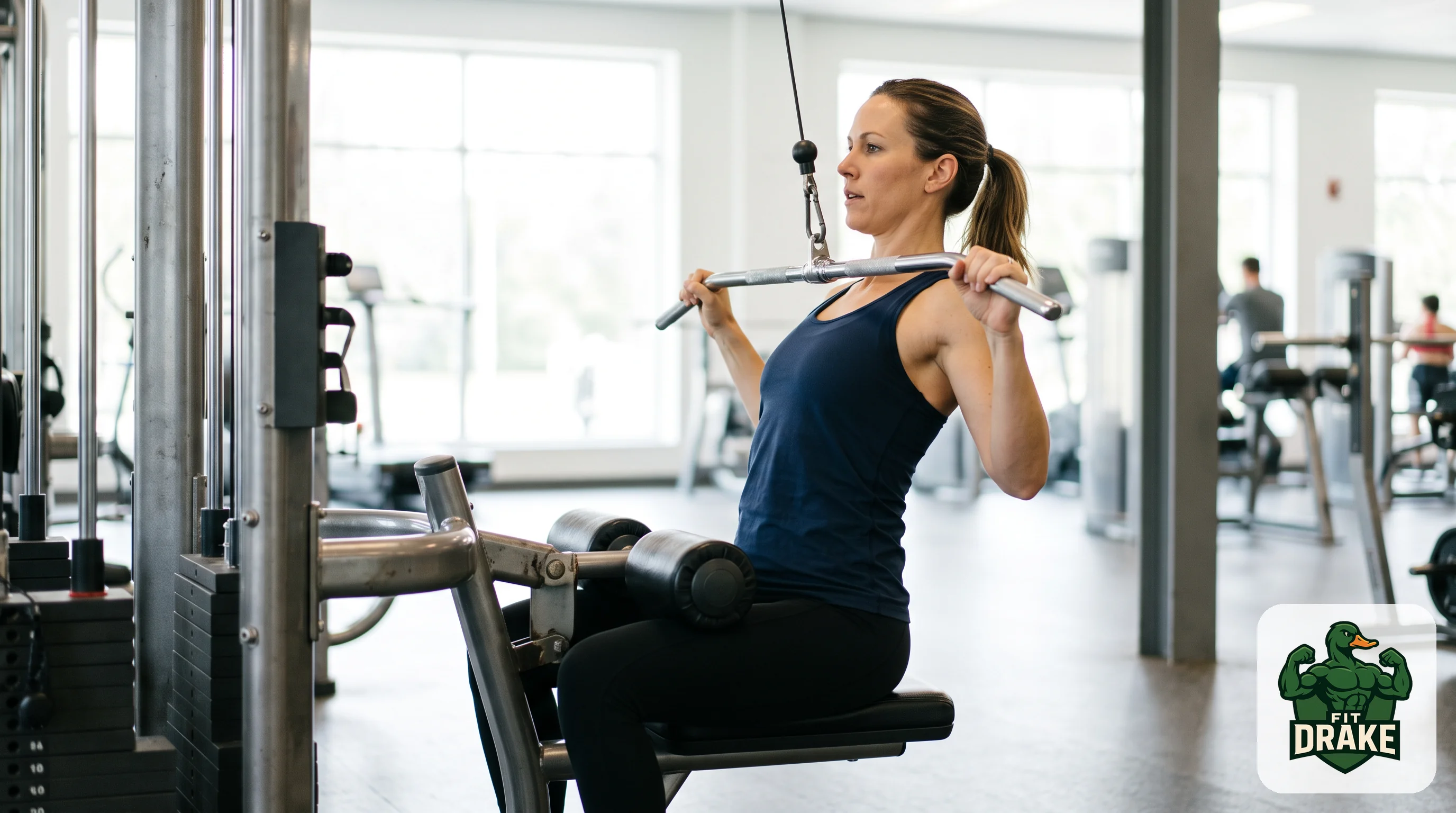
For a pull, the lat pulldown is a good place to start. Sit with your thighs snug under the pads, grip the bar a little wider than your shoulders, and pull your elbows down and back toward your sides while keeping your chest tall. Control the bar on the way up.
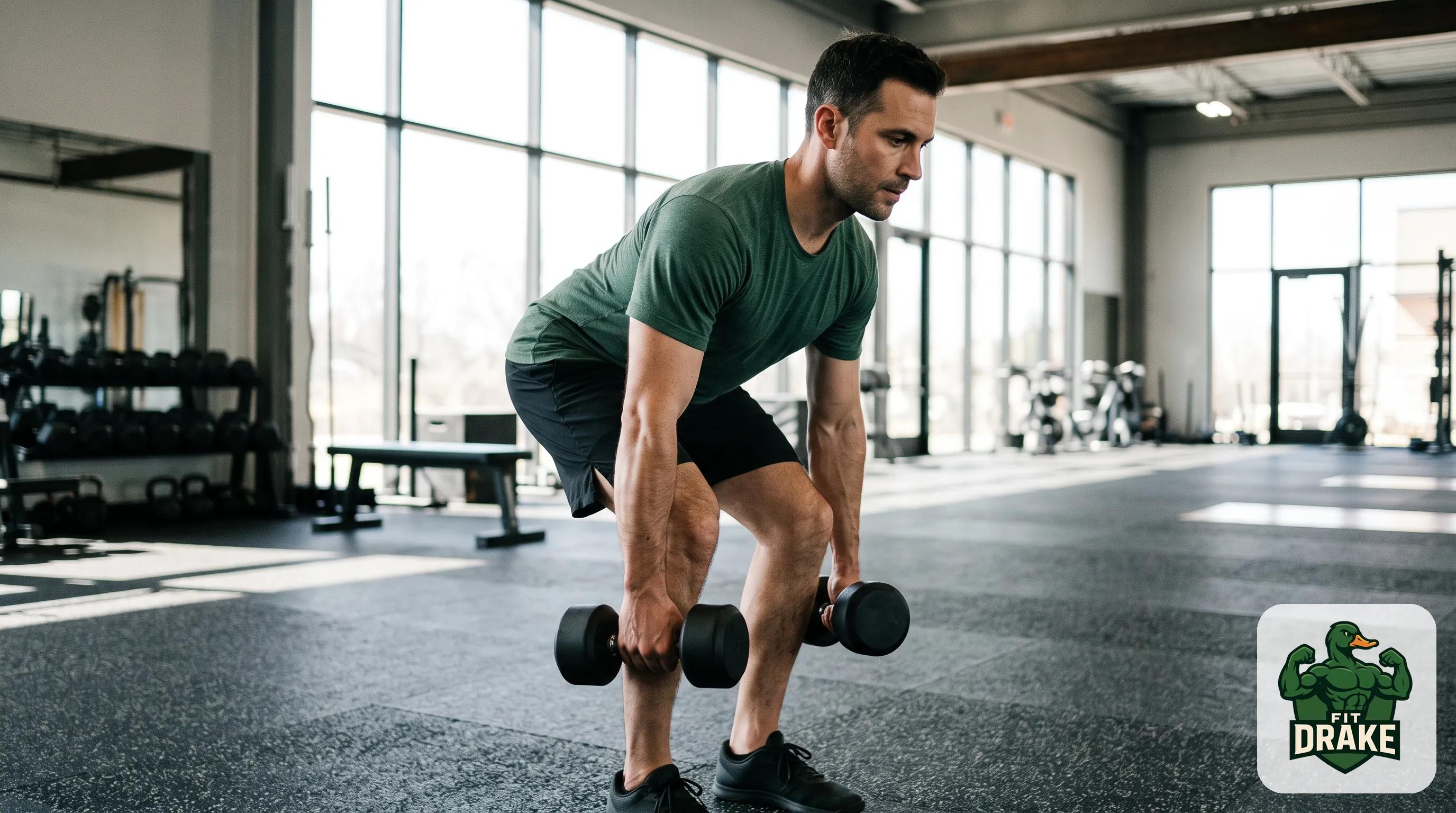
For a hinge, the dumbbell Romanian deadlift teaches the hip-back motion. Stand tall with a dumbbell in each hand, soften your knees, push your hips back while keeping your back flat, lower the weights to about knee height, then stand up by driving your hips forward. If your back rounds, the weights are too heavy or you're going too low.
If you're unsure how a movement should look, FitDrake has 582 exercises with video clips, filtered to your equipment, in its [exercise library](https://fitdrake.com/exercises/). When a machine is taken or a move feels wrong for you, you can swap any exercise for one of three alternatives that work the same muscles with your equipment.
## How many sets, reps and rest do beginners need?
A common starting point for beginners is 2 to 3 sets of 8 to 12 reps per exercise, resting 1 to 3 minutes between sets. The ACSM position stand recommends that novice lifters use loads in the 8 to 12 repetition range, and it suggests 1 to 2 minutes of rest between sets for hypertrophy-focused training. Heavier compound lifts, like the leg press or a squat, often feel better with a bit more rest, closer to 2 or 3 minutes.
Treat these as starting points, not rules. Individual needs vary, and the ACSM itself says recommendations should be adjusted to your goals, physical capacity and training status. Begin with 2 sets per exercise in your first week or two while you learn the movements, then move to 3 if recovery feels fine.
Sets and reps also tell you how long a session takes. A warm-up of 5 to 10 minutes, plus 5 or 6 exercises at 2 to 3 sets with a couple of minutes of rest, lands at roughly 45 to 60 minutes. That's an estimate from the arithmetic, not a study result, and it's a good size for a beginner.
## How do you pick a starting weight and how hard should you push?
Pick a weight you could lift for about 3 more reps than you plan to do, with good form on every rep. That idea is called reps in reserve (RIR): if you stop a set with 3 reps in reserve, you could have done 3 more with the same form. For most working sets, aim to finish with about 1 to 3 reps in reserve, meaning hard but not at your limit.
Here's how to find the weight on a new exercise:
1. Start with a light weight and do 8 to 10 easy reps as a practice set.
2. Add a little weight and repeat until a set of 8 to 12 feels challenging but clean.
3. Choose the weight where your last rep still looks like your first, and you'd have about 2 to 3 reps left.
In your first 2 weeks, stay on the easier side, closer to 3 reps in reserve. That's a common coaching approach, not a study finding, and it gives your technique time to catch up. Muscle soreness for a day or two is normal. Sharp or lasting pain isn't: stop that exercise and talk to a doctor or physical therapist before you continue.
## How do you progress from week to week?
Use double progression: add reps until you reach the top of your rep range on every set, then add the smallest weight jump and start the range again. This is the simplest form of progressive overload, which means gradually asking your body to do a bit more over time.
The ACSM position stand gives a numeric guide: when you can do 1 to 2 reps more than your target at the current load, increase the load by about 2 to 10 percent. Dumbbells often jump in bigger steps than that, so you may need to stay at one weight for a few extra weeks before moving up.
Here's what that can look like on a lat pulldown over 5 weeks, with a target of 3 sets of 8 to 12 reps. These numbers are only an example, not a recommendation, because your weights and reps will differ:
| Week | Weight | Set 1 | Set 2 | Set 3 | What you do next |
|---|---|---|---|---|---|
| 1 | 50 lb | 8 | 8 | 8 | Keep the weight and aim for 1 more rep per set |
| 2 | 50 lb | 10 | 9 | 9 | Keep the weight and keep adding reps |
| 3 | 50 lb | 12 | 11 | 10 | Keep the weight until every set reaches 12 |
| 4 | 50 lb | 12 | 12 | 12 | Top of the range on every set, so add the smallest jump |
| 5 | 55 lb | 9 | 8 | 8 | Climb the range again from the lower end |
The jump from 50 to 55 pounds is 10 percent, which sits at the top of the ACSM's range. Reps drop when the weight goes up, and that's expected. If a week goes badly, repeat it. Slow, steady and repeatable beats rushed and sore. For a deeper explanation of how to apply this to any lift, see our guide to [progressive overload](https://fitdrake.com/blog/progressive-overload-explained/).
## Do you need to warm up and cool down?
Yes, a short warm-up is worth doing before every session, and a cool-down is optional. A good beginner warm-up takes 5 to 10 minutes: easy cardio such as walking or a bike to raise your body temperature, a few arm and hip circles, then 1 or 2 lighter sets of your first exercise before you start your real sets.
A cool-down can be as simple as a few minutes of easy walking and some gentle stretches for the muscles you used. It's about winding down, and it's fine to skip when time is tight. The warm-up is the one that matters.
## Where do cardio and mobility fit in a beginner gym week?
Fit them around your lifting, not in front of it. Easy cardio such as walking, cycling or a gentle jog works well on non-lifting days or after your strength work, so you aren't tired before your heavy sets. The CDC's adult guidelines recommend 150 minutes of moderate-intensity activity a week in addition to the muscle-strengthening days, but you can build toward that gradually.
For mobility, a short 5 to 10 minute routine of hip, shoulder and upper-back movements on a rest day is plenty. Keep it light. Cardio and mobility should help you recover and show up for the next session, not leave you too tired to lift.
## What does a sample beginner gym week look like?
A simple sample week alternates two full-body workouts, A and B, across 3 non-consecutive days. This is a starting template, so change the exercises to match your gym and swap in the free-weight options when a machine is busy:
| Day | Workout |
|---|---|
| Monday | Workout A |
| Tuesday | Rest, or an easy walk |
| Wednesday | Workout B |
| Thursday | Rest, or an easy walk |
| Friday | Workout A (next week: Workout B) |
| Saturday and Sunday | Rest, easy walks, or 5 to 10 minutes of mobility |
Alternating A and B across weeks means each workout gets trained about the same number of times over several weeks. Each workout uses all five patterns:
| Pattern | Workout A | Workout B | Sets x reps |
|---|---|---|---|
| Squat | Leg press or goblet squat | Goblet squat or leg press | 3 x 8-12 |
| Hinge | Dumbbell Romanian deadlift | Seated leg curl | 3 x 8-12 |
| Push | Chest press machine or dumbbell bench press | Seated shoulder press (machine or dumbbells) | 3 x 8-12 |
| Pull | Lat pulldown | Seated cable row or one-arm dumbbell row | 3 x 8-12 |
| Core | Plank, 2 sets | Farmer's carry, 2 rounds | 2 sets |
Start with 2 sets per exercise in week 1, as mentioned above, and move to 3 once the movements feel familiar. Rest 1 to 3 minutes between sets.
## How do you build your own gym routine from this template?
Build your own routine by filling in a simple table: one row per exercise, with the sets, reps, weight and notes you'll record each session. Copy this layout into a notebook or notes app and fill in your choices from the movement-pattern table above:
| Day | Exercise | Sets x reps | Weight | Notes |
|---|---|---|---|---|
| Workout A | Squat pattern: | 3 x 8-12 | | |
| Workout A | Hinge pattern: | 3 x 8-12 | | |
| Workout A | Push pattern: | 3 x 8-12 | | |
| Workout A | Pull pattern: | 3 x 8-12 | | |
| Workout A | Core or carry: | 2 sets | | |
Make a second copy for Workout B with different exercises in the same patterns. Then pick your days, write the start weights from your practice sets, and put a number in the notes column whenever something feels off. Fill in the weights the first time you do each exercise, not before.
If you'd rather not fill in the template yourself, FitDrake's [AI workout planner](https://fitdrake.com/ai-workout-planner/) builds your plan (exercises, sets, reps and rest) from your goal, schedule, equipment and training level. The plan is built for a full gym, dumbbells at home or bodyweight only, and never prescribes equipment you don't have.
## Is a beginner gym plan different for women?
No. The principles are the same: 2 to 3 full-body days, the five movement patterns, 8 to 12 reps, a few reps in reserve and gradual progression. Nothing about the structure above changes based on gender, and there's no separate set of rules you need to follow.
What does differ is personal preference and circumstances. Some people starting at the gym, including many women, like the machine options in the table because they guide the movement and feel less intimidating, and that's a perfectly good way to begin. Move to free weights when you feel ready, not because anyone says you should. If you're pregnant, postpartum or managing a medical condition, check with your doctor before starting or changing a program.
## How do you make the plan work for building muscle?
To build muscle as a beginner, train every major muscle group at least twice a week, work your sets close to your limit with good form, progress the weights or reps over time, and eat and sleep enough to recover. The plan above already does the first three things.
With 3 full-body days of 3 sets per exercise, each muscle gets roughly 6 to 9 hard sets a week from the main lifts, if each muscle gets one main exercise per session. The ACSM position stand notes that higher-volume, multiple-set programs are recommended for maximizing hypertrophy, which means muscle growth, so 3 sets beats 1. Finishing sets with 1 to 2 reps in reserve instead of 3 is a way to make them harder once your form is solid.
Eating enough protein and enough food overall supports muscle gain. If you'd like specific targets, a registered dietitian can tailor them to you. Muscle takes time to build, and no plan can promise how much you'll gain or how fast.
## How much rest and sleep do you need?
Take at least one rest day between lifting sessions, and sleep on a regular schedule. Muscles recover between workouts, not during them, so recovery is part of the plan rather than time off from it.
Signs you're recovering well include steady energy, performance that holds or improves, and soreness that fades within a couple of days. If you feel run down for a week or more, or your numbers keep dropping, cut a set from each exercise for a week and reassess. Persistent pain, dizziness or anything that feels wrong is a reason to stop and see a doctor.
## Why should you track every session?
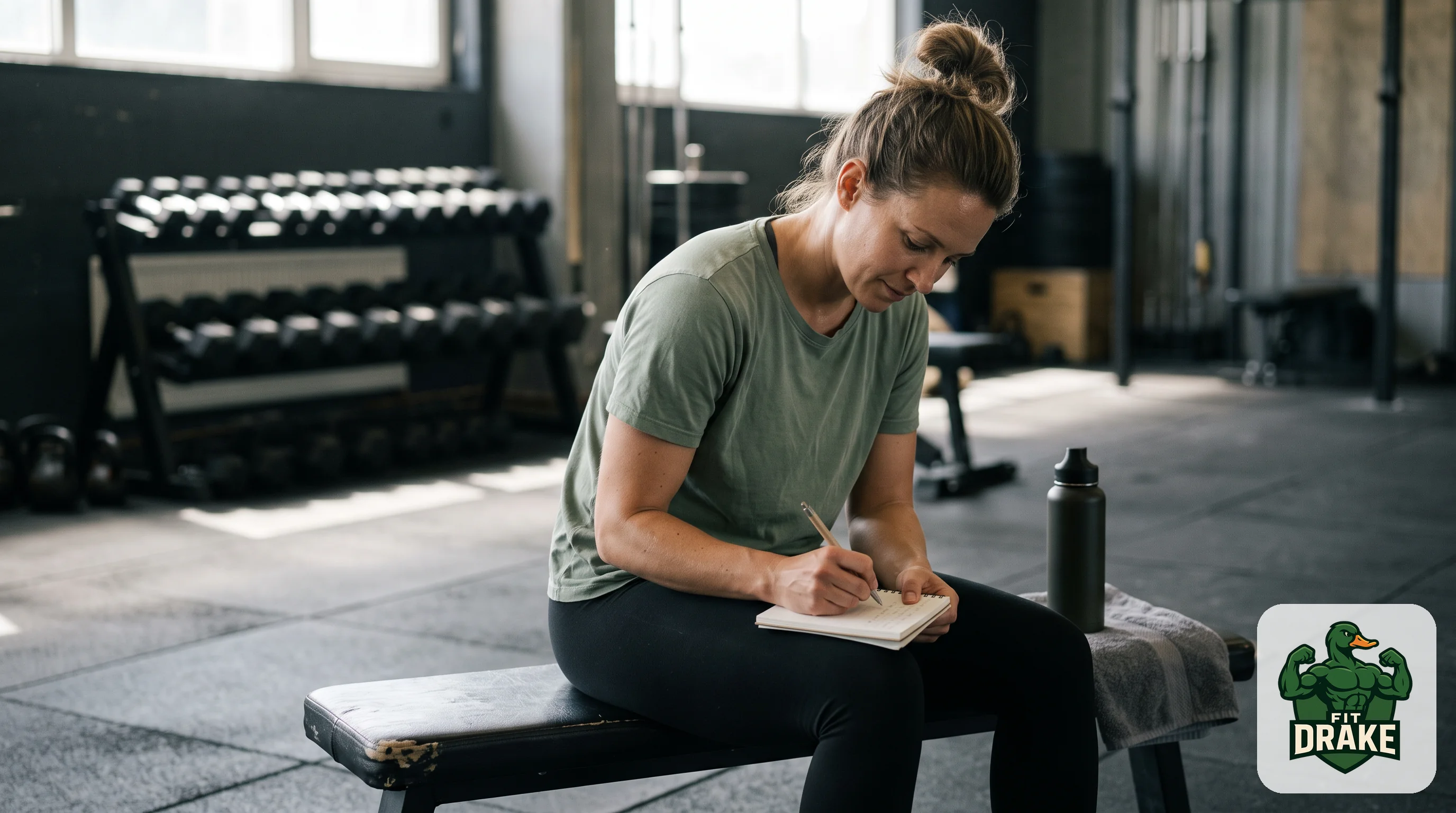
Tracking tells you what to do next. Write down each exercise, the sets, the reps, the weight and one note about effort. Before your next session, look at what you did last time, and aim to beat one number: one more rep, or a small increase in weight. Without a log, double progression is guesswork.
Keep notes short. Add a comment only when something is surprising, such as a weight that felt much easier or harder than expected, so you know why the numbers moved. For more on what to write down and how to review it, see our guide to a [workout journal app for iPhone](https://fitdrake.com/blog/workout-journal-app-for-iphone/).
If you'd rather not track by hand, FitDrake's journal keeps everything you logged, day by day. With a paid FitDrake plan, the workout player walks you through sets, reps and the rest timer, and when you finish a week, the next one is built from what you actually logged.
## What should you do after the first 4 to 8 weeks?
Keep the same plan as long as your numbers are still moving up. A plan doesn't expire after a set number of weeks. Change it when progress stalls for several weeks in a row, when you're bored enough to skip sessions, or when you're ready for more days.
When you do change something, change one thing at a time: swap an exercise for another in the same pattern, add a fourth day as an upper/lower split, or take an easier week and then build back up. A lighter week every so often, called a deload, is a common practice among lifters when fatigue builds. If you're not sure whether to change anything, stay with the plan for a few more weeks.
## Frequently asked questions
### How many days a week should a beginner go to the gym?
Most beginners do well with 2 to 3 days a week, with a rest day between sessions. The CDC recommends muscle-strengthening on at least 2 days a week, and the ACSM recommends 2 to 3 days a week for novice lifters.
### How long should a beginner workout be?
About 45 to 60 minutes, including a 5 to 10 minute warm-up. That's roughly the time that 5 or 6 exercises of 2 to 3 sets with rest in between takes. If you're short on time, drop a set from each exercise rather than skipping the session.
### Should beginners do full body or a split?
Full body is the simpler choice. Training the whole body 2 to 3 times a week works every major muscle group at least twice, which fits the research on training frequency. A split makes more sense later, when you want to train 4 or more days a week.
### When should I increase the weight?
Increase the weight when you can complete every set at the top of your rep range with good form. Use the smallest jump available, and expect your reps to drop for a week or two before they climb again.
### Is the plan different for women?
No. The days, movement patterns, rep ranges and progression rule are the same. Choose machines or free weights based on comfort, and check with your doctor first if you're pregnant or have a health condition.
### How do I make a workout plan to build muscle?
Use the same full-body plan, train each muscle at least twice a week, do 3 sets per exercise once you're comfortable, finish sets with a few reps in reserve, and add reps and then weight over time. Eat enough overall and sleep well.
## Want FitDrake to plan this for you?
If you want a plan that's built from your goal, schedule and equipment, [download FitDrake on the App Store](https://apps.apple.com/us/app/fitdrake/id6752671092) and start with the free plan. FitDrake is for iPhone, with an Apple Watch app for logging at the gym.
## Key takeaways
- Plan in 7 steps: goal, days, structure, exercises, sets and reps, starting weight, progression and tracking.
- Most beginners do well with full-body workouts on 2 to 3 non-consecutive days a week.
- Choose exercises by movement pattern (squat, hinge, push, pull, core) with a machine and a free-weight option for each.
- Start with 2 to 3 sets of 8 to 12 reps, rest 1 to 3 minutes, and finish most sets with about 1 to 3 reps in reserve.
- Use double progression: add reps to the top of the range, then add the smallest weight jump.
- Track every session so you know what to beat next time, and treat the numbers here as starting points, not rules.
- Stop any exercise that causes pain, and check with a doctor before starting if you're pregnant, injured or managing a health condition.