4-Day Upper/Lower Split at Home: No-Equipment Plan
A 4-day upper/lower split at home trains your upper body on two days and your lower body on two days, so every major muscle group gets worked twice a week without any gym equipment. A simple layout is Upper A on Monday, Lower A on Tuesday, rest on Wednesday, Upper B on Thursday, and Lower B on Friday, with 2 to 4 sets per exercise and most sets ending with 1 to 3 reps still in the tank. All you need is a floor, a sturdy chair, a towel, and a solid door frame or table, and you make each exercise harder once you hit the top of its rep range.
Written by FitDrake Team, updated on November 19, 2026
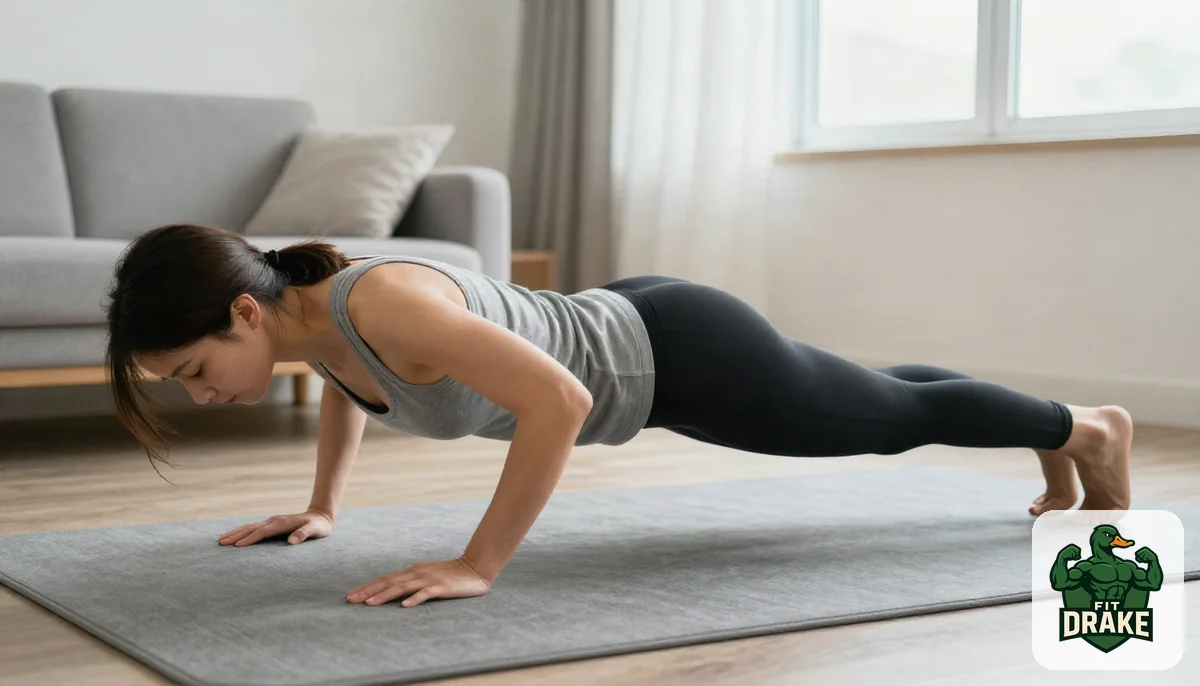
Training at home without weights raises two fair questions: can bodyweight work actually build muscle, and how do you organize it so you are not doing the same 20-minute circuit forever? The research is encouraging on the first point. The American College of Sports Medicine's 2026 position stand, which pooled 137 systematic reviews, concluded that home-based training, elastic bands, and bodyweight exercise all produce meaningful gains in strength and muscle size, and that consistency matters more than a perfect program (ACSM 2026 resistance training guidelines).
An upper/lower split handles the second point. It gives each session a clear job, keeps most workouts in the 35- to 50-minute range, and hits every muscle group twice a week, which lines up with the CDC's recommendation of muscle-strengthening activity on at least 2 days a week. Below you will find the weekly schedule, all four workouts, how many sets to do, how long to rest, and exactly how to make each exercise harder as you get stronger.
What is a 4-day upper/lower split?
It is a weekly plan with two upper-body sessions (chest, back, shoulders, and arms) and two lower-body sessions (quads, glutes, hamstrings, calves, and core). Because each half of the body is trained twice, every muscle gets two doses of work per week with a few days to recover in between.
Twice a week is a sensible target, and it is what the same ACSM guidelines recommend for every major muscle group. The split itself is not magic, though. Studies comparing split routines with full-body routines generally find similar strength and muscle gains when total weekly volume is matched. Choose upper/lower because four shorter, focused sessions fit your week, not because it beats everything else.
What do you need to do this plan at home?
No gym equipment, but a few household items make the pulling and single-leg work possible:
- A floor with some space, ideally with a mat or rug for floor exercises.
- A sturdy chair, bench, or bottom stair for split squats, step-ups, and hip thrusts.
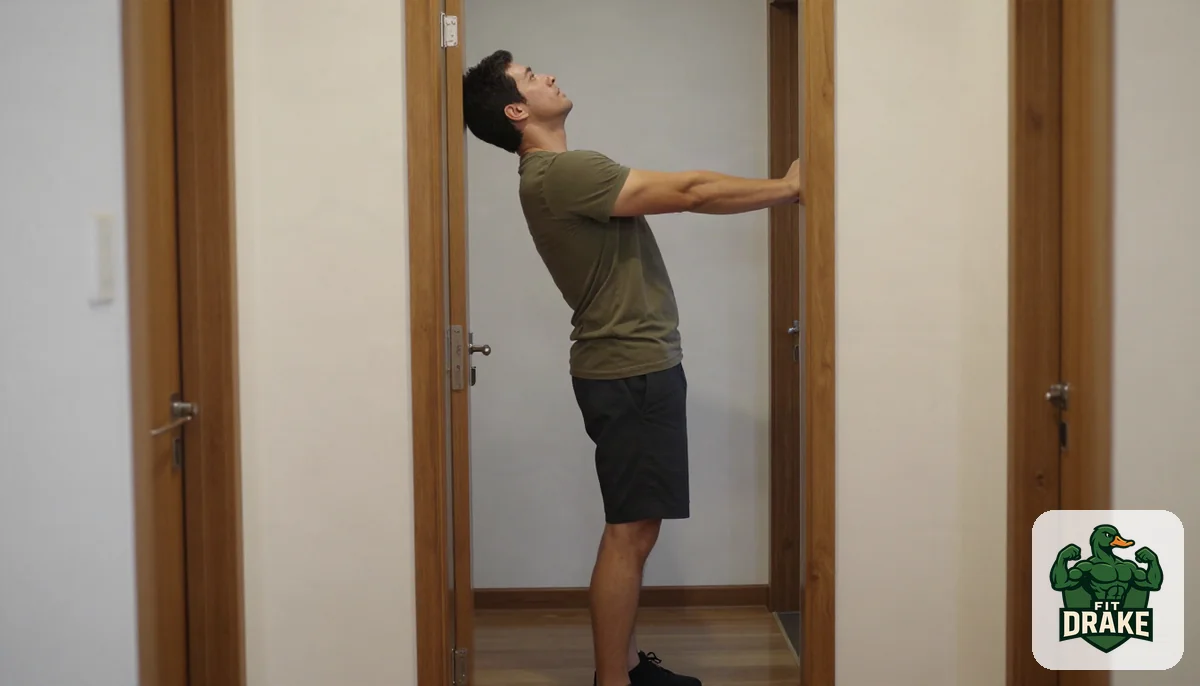
- A solid door frame or a heavy, stable table for rows. Test it before you trust it: the table should not tip or slide when you lean on its edge, and the door frame should be part of the wall, not a hollow trim piece.
- A towel for sliding leg curls on a smooth floor (socks on a hardwood floor work too).
- Optional: a backpack you can load with books to make lower-body moves harder later.
If you own a pull-up bar, you can swap pull-ups in for the rows on either upper day.
What does the weekly schedule look like?
Train on four days and keep at least one rest day between the two pairs of sessions:
| Day | Session | Focus |
|---|---|---|
| Monday | Upper A | Horizontal push and pull |
| Tuesday | Lower A | Squat and hinge patterns |
| Wednesday | Rest or easy walk | Recovery |
| Thursday | Upper B | Pulling volume and overhead pressing |
| Friday | Lower B | Single-leg strength and hamstrings |
| Saturday | Rest or easy activity | Recovery |
| Sunday | Rest | Recovery |
The days are flexible. Saturday, Sunday, Tuesday, and Wednesday works just as well, as long as you avoid doing the same session type on back-to-back days and keep the order Upper A, Lower A, Upper B, Lower B.
What are the four workouts?
Each workout lists sets and a rep range. Pick the variation that lets you land inside that range with clean form; the next section explains how to adjust. Rest about 1 to 2 minutes between sets of the first two exercises and 60 to 90 seconds on the rest.
Upper A: push and row
| Exercise | Sets | Reps |
|---|---|---|
| Push-up (incline on a counter or table if needed) | 3 | 6 to 15 |
| Inverted row under a sturdy table (or doorway row) | 3 | 6 to 15 |
| Pike push-up | 3 | 5 to 12 |
| One-arm doorway row | 2 | 8 to 15 per side |
| Close-grip push-up | 3 | 6 to 15 |
| Prone Y-T raise | 2 | 10 to 15 |
Lower A: squat and hinge
| Exercise | Sets | Reps |
|---|---|---|
| Bodyweight squat (pause at the bottom once it gets easy) | 3 | 10 to 20 |
| Single-leg Romanian deadlift, bodyweight | 3 | 8 to 12 per side |
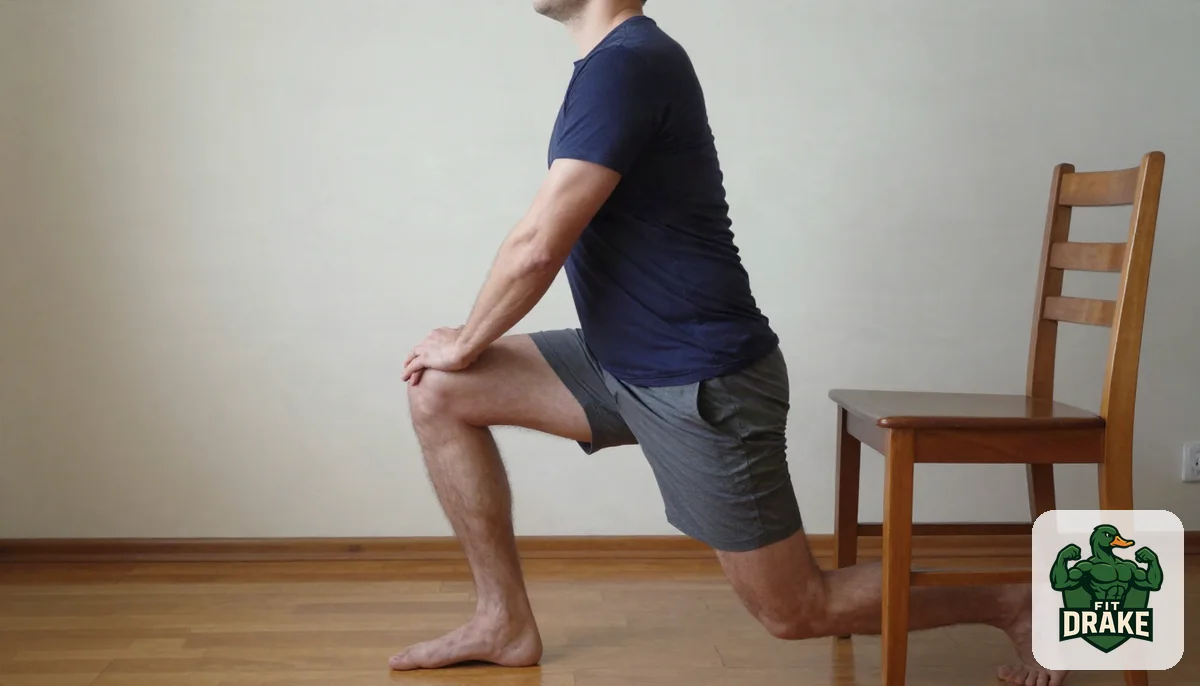
| Reverse lunge | 3 | 8 to 12 per side |
| Single-leg calf raise on a step | 3 | 10 to 20 per side |
| Front plank | 3 | 20 to 45 seconds |
Upper B: pull and press overhead
| Exercise | Sets | Reps |
|---|---|---|
| Inverted row, feet elevated once bent-knee rows get easy | 4 | 6 to 15 |
| Push-up or decline push-up (feet on a chair) | 4 | 6 to 15 |
| Pike push-up, feet elevated when ready | 3 | 5 to 10 |
| Backpack bent-over row (load it with books) | 3 | 10 to 15 |
| Prone W raise | 2 | 10 to 15 |
| Side plank | 2 | 20 to 40 seconds per side |
Lower B: single-leg and hamstrings
| Exercise | Sets | Reps |
|---|---|---|
| Bulgarian split squat (rear foot on a chair) | 3 | 8 to 12 per side |
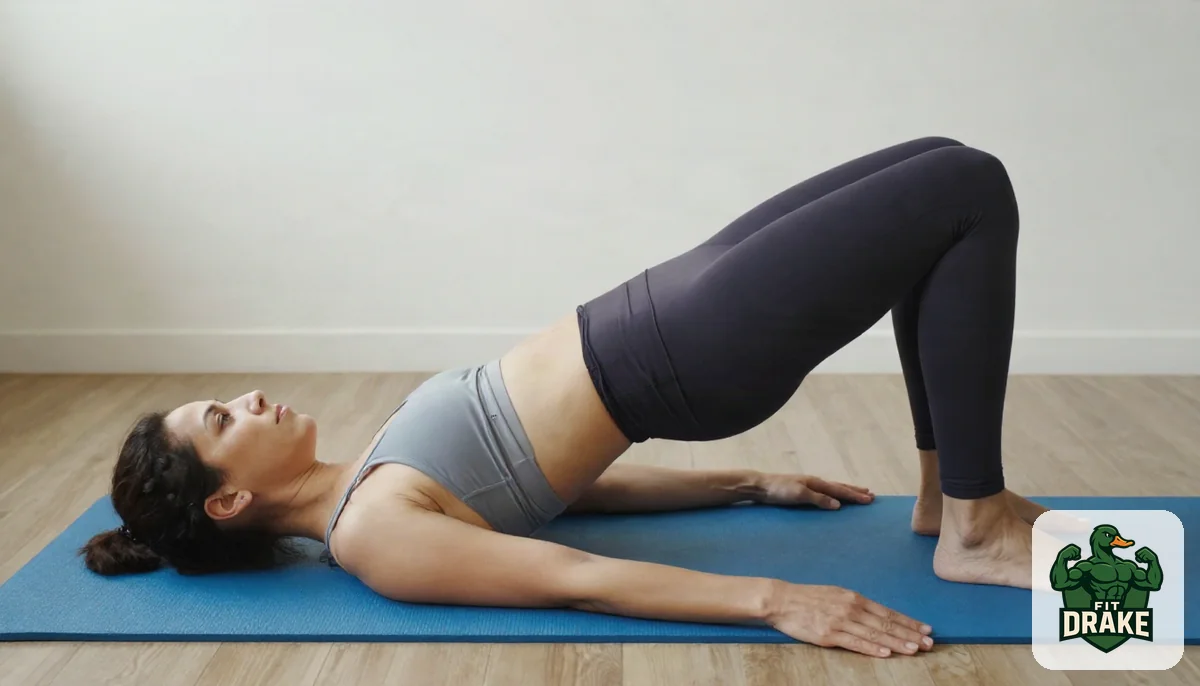
| Glute bridge, or hip thrust with shoulders on the couch | 3 | 10 to 20 |
| Sliding leg curl on a towel | 3 | 8 to 12 |
| Step-up onto a sturdy step or chair | 2 | 10 to 12 per side |
| Wall sit | 2 | 30 to 60 seconds |
| Single-leg calf raise on a step | 2 | 10 to 20 per side |
| Dead bug | 3 | 8 per side |
Add it up and your chest, back, shoulders, quads, and glutes each get about 10 or more hard sets per week from exercises that work them directly, with hamstrings close behind. That is in line with the roughly 10 sets per muscle group per week that the ACSM's 2026 guidelines associate with muscle growth.
How many sets and reps should you do?
Start with the lower number of sets listed for the first two weeks, then move to the full prescription. Weekly volume is one of the clearest drivers of muscle growth, and more sets generally mean more growth. Extra sets only help when you can recover from them, though, so build up gradually rather than jumping straight to the maximum.
Effort matters more than the exact rep number. Bodyweight exercises are lighter loads, and that is fine: research comparing light and heavy loads has found similar muscle growth when sets are taken close to failure, while heavier loads still do better for maximal strength.
You do not have to grind every set to failure, though. The ACSM's 2026 guidelines note that training to momentary failure did not consistently improve outcomes for healthy adults. A practical target is to finish most sets feeling that you could have done 1 to 3 more clean reps. If you could have done 6 more, the variation is too easy.
How long should you rest between sets?
Rest about 1 to 2 minutes between sets of the main exercises, and 60 to 90 seconds on smaller moves like Y-T raises, calf raises, and planks. That range is a common recommendation for muscle-building work with moderate loads.
Longer rest is not wasted time. Resting long enough to repeat a good set usually serves you better than rushing, especially on the hardest exercises. If your reps drop sharply from one set to the next, rest longer rather than cutting the set short.
If you'd rather not unlock your phone to check the clock between sets, FitDrake shows your workout as a Live Activity on the lock screen, so you can follow the rest timer and tap Done without unlocking. With the Apple Watch app, you can log sets with the Digital Crown and see the rest countdown on your wrist.
How do you make bodyweight exercises harder over time?
Use one simple rule: when you can complete every set at the top of the rep range with good form, make the exercise harder at your next session. This is progressive overload, the same principle lifters use when they add a little weight once they can beat their target reps. Without weights, you raise the difficulty in other ways, in roughly this order:
- Add reps until you reach the top of the range.
- Slow the lowering phase to 3 seconds and add a 1-second pause at the bottom.
- Change the leverage by moving to a harder variation (see the table below).
- Add a set to your weakest exercises.
- Add load with a backpack for squats, lunges, step-ups, and hip thrusts.
| Movement | Easier | Standard | Harder |
|---|---|---|---|
| Push-up | Incline push-up on a counter | Floor push-up | Decline push-up, feet on a chair |
| Row | Doorway row, feet far from the frame | Table row, knees bent | Table row, legs straight or feet elevated |
| Overhead press | Pike push-up, hands on a step | Pike push-up on the floor | Pike push-up, feet on a chair |
| Squat | Sit-to-stand from a chair | Bodyweight squat | Bulgarian split squat |
| Hinge | Glute bridge | Single-leg glute bridge | Single-leg hip thrust on the couch |
| Hamstrings | Sliding leg curl, eccentric only | Sliding leg curl | Single-leg sliding leg curl |
When a move drops you back to the bottom of the rep range, that is expected. Work back up to the top before progressing again.
If you'd rather not track every set and rep by hand to know when to progress, log your workouts in FitDrake: when you finish a week, the next one is built from what you actually logged.
What if you can't do a push-up or a row yet?
Start where you are. Every exercise in this plan has an easier version that trains the same muscles:
- Push-ups: do them with your hands on a kitchen counter, then a table, then a low step, before moving to the floor. Our push-up form guide covers hand position and common mistakes.
- Rows: start with a doorway row, standing close to the frame so you lean back only slightly. Step your feet farther forward to make it harder.
- Pike push-ups: keep your hands on a step to reduce the load on your shoulders, and lower only as far as you control.
- Split squats and lunges: hold a wall or chair back for balance and use a shorter range of motion at first. See the Bulgarian split squat guide for setup and form cues that also apply to lunges.
- Sliding leg curls: do only the lowering part, then reset with your hips down.
If a move is still too hard, or you don't have the setup for it, FitDrake lets you swap any exercise for one of three alternatives that work the same muscles with your equipment. You can also mark body parts you need to protect, and they are left out of your plan and the swap suggestions.
Safety note: Stop any exercise that causes sharp or joint pain, as opposed to the normal burn of hard effort. Check that tables, chairs, and door frames are stable before loading them with your body weight. If you have an injury, a health condition, or are pregnant, talk with a health care provider or a qualified professional before starting a new program. This guide is general information, not medical advice.
Frequently asked questions
How many rest days do you need on an upper/lower split?
Most people do well with three rest days a week, for example Wednesday plus the weekend. The key is not training the same session type on consecutive days, so each muscle group gets a few days to recover before its next workout.
Can you build muscle with just bodyweight?
Yes, as long as the exercises are challenging enough and you keep making them harder. Research comparing light and heavy loads has found similar muscle growth when sets are taken close to failure, and the ACSM's 2026 guidelines list bodyweight and home-based training as effective options. Heavier loads still have the edge for building maximal strength.
Can you progressive overload at home?
Yes. Instead of adding plates, you add reps, slow the lowering phase, pause at the bottom, move to a harder variation, add a set, or load a backpack. The progression table above shows one path for each movement.
Is an upper/lower split good for beginners?
It can be, if you can reliably train four days a week. If three days is more realistic, a full-body routine three times a week trains each muscle just as often and fits better. Studies suggest both approaches produce similar results when weekly volume is matched, so pick the schedule you will actually keep.
Can you do cardio with an upper/lower split?
Yes. The CDC recommends at least 150 minutes of moderate-intensity aerobic activity a week alongside 2 days of muscle-strengthening work. Brisk walks on your rest days or short, easy sessions after lower-body workouts are simple ways to fit it in. Save hard intervals for days that are not followed by a lower-body session.
How often should you do calisthenics workouts?
For building muscle, training each muscle group about twice a week is a good target, which this four-day split delivers. Brief, easy practice of a skill like push-ups on other days is fine, but leave hard sessions for the scheduled days so you can recover.
Can you do an upper/lower split with no rest days?
It is possible because upper and lower days alternate, but it is rarely worth it at home. Your core, grip, and stabilizers work in every session, and recovery is when adaptation happens. Starting with at least one or two full rest days per week is the safer choice.
Want this plan built for you?
FitDrake can build a home plan like this one around your week. Set your equipment to bodyweight only and it never prescribes equipment you don't have, while the AI workout planner fits the plan to your goal, schedule, and training level. Every exercise comes from a library of 582 exercises with video clips, so you can check your form before the first set.
Download FitDrake on the App Store and start with the free plan, which includes one goal, one AI workout plan, and weight and measurement tracking. The app runs on iPhone with iOS 17 or later.
Key takeaways
- A 4-day upper/lower split trains each major muscle group twice a week, in line with the CDC's minimum of 2 days of muscle-strengthening activity.
- You can run the whole plan at home with a floor, a sturdy chair, a towel, and a solid door frame or table.
- End most sets with 1 to 3 clean reps left, and rest about 1 to 2 minutes on the main exercises.
- Progress by adding reps, slowing the lowering phase, moving to a harder variation, adding a set, or loading a backpack.
- Every move has an easier version, so start where you are and stop any exercise that causes sharp or joint pain.