Both ChatGPT and Claude can write a reasonable beginner or intermediate workout plan, as long as you tell them your goal, schedule, equipment, experience and limitations. The differences that matter in practice are smaller than most comparisons suggest: how well each follows the format you ask for, what it remembers between chats, and whether it can work with a plan and log that live outside the chat. Neither one can see how your sessions actually went unless you tell it or connect an app that tracks them.
Written by FitDrake Team, updated on November 24, 2026
Asking an AI assistant for a workout plan takes about a minute. Deciding whether to trust that plan, and keeping it useful after the first week, is the hard part. This guide compares ChatGPT and Claude for that specific job: what each does well, what both miss, what the research actually found, a prompt you can copy, and how to keep your plan and progress in one place once you start training.
Which is better for a workout plan, ChatGPT or Claude?
The short answer: for a typical beginner or intermediate plan, either one works, and your prompt matters more than the assistant you pick. Use the one you already pay for or already have open, give it complete details, and judge the plan on the checks in this guide rather than on the brand.
There is one controlled study that compared models on exercise prescriptions, and an older Claude model scored highest in it. That's a useful data point, not proof that today's Claude beats today's ChatGPT for your plan. Both companies update their models and features often, so the practical differences shift from month to month. Gemini and other assistants can handle the same request with the same prompt; this guide sticks to ChatGPT and Claude because that's the choice most people are weighing.
Can ChatGPT create a workout plan for you?
Yes. ChatGPT can create a workout plan for you, and so can Claude. Ask for a weekly schedule with exercises, sets, reps and rest, and both will produce something that looks like a real program within seconds.
What they produce depends almost entirely on what you give them. A one-line request such as "make me a workout plan" gets a generic full-body routine that may assume a gym you don't have or a schedule you can't keep. A detailed request gets a plan built around your days, your equipment and your experience. The assistant doesn't ask screening questions on its own unless you prompt it to, so the job of filling in the gaps falls to you.
What does ChatGPT do well, and where does it fall short?
Where ChatGPT tends to help most is continuity. Its Memory feature can draw on saved memories, custom instructions and past chats, so it can pick up details like your training days or a sore shoulder without you repeating them, according to OpenAI's Memory help article. OpenAI notes that memory features and controls vary by plan, region and platform, and that ChatGPT doesn't retain every detail from every conversation.
Where ChatGPT falls short for training is the same place every chat assistant does. It only knows the numbers you type in. If you skip a session, swap an exercise or stall on a lift, nothing changes unless you report it. Memory can also hold onto outdated details, so check what it has saved if your goal or schedule changes.
ChatGPT can also connect to outside tools through custom MCP servers, but OpenAI's help center currently lists full support for Business and Enterprise/Edu workspaces and read-only access on Pro. If you're on another plan, assume your workout plan stays in the chat.
What does Claude do well, and where does it fall short?
Where Claude tends to stand out is in the one study that compared models on exercise prescriptions, where Claude 3.7 had the highest total score and scored especially well on progression and session time. It also offers chat search on paid plans and memory that can carry context into new conversations, according to Anthropic's help center.
Claude's other practical strength for this job is connectors. Anthropic says custom connectors using remote MCP are available on Free and paid plans, with Free users limited to one custom connector. That means Claude can work with an app that holds your real plan and workout history instead of a plan that only exists in the chat.
Where Claude falls short is the same as ChatGPT: it can't see your form, doesn't know your health history unless you share it, and can't tell whether last week's sets felt easy or brutal. A strong score on a study's expert ratings doesn't change that.
How do ChatGPT and Claude compare side by side?
Side by side, the two are closer than most "versus" articles suggest. The table sticks to what each company documents and what the study measured, not to impressions.
| What you need for a workout plan | ChatGPT | Claude |
|---|---|---|
| Drafts a plan from a detailed prompt | Yes | Yes |
| Remembers you across chats | Memory can use saved memories, custom instructions and past chats; varies by plan and region | Chat search on paid plans; memory can carry context into new conversations |
| Works with an app that holds your real plan | Custom MCP servers: full support on Business and Enterprise/Edu, read-only on Pro | Custom connectors via remote MCP on Free (one connector) and paid plans |
| Score in the 2026 FITT-VP study (older models) | GPT-4o: 44.02 of 60 | Claude 3.7: 50.23 of 60 |
| Knows your injuries, form and how sessions went | Only what you tell it | Only what you tell it |
Features in the first three rows change often. Check your own plan's settings before you rely on any of them.
What does the research say about AI workout plans?
The most relevant research is a 2026 study in Frontiers in Physiology that asked four models (GPT-4o, Claude 3.7, DeepSeek R1 and Grok-3) to write exercise prescriptions for 30 synthetic patient profiles. Three certified exercise specialists rated each prescription from 0 to 10 on six parts of the FITT-VP framework: frequency, intensity, time, type, volume and progression.
According to the published study, Claude 3.7 had the highest total score (50.23 out of 60), followed by Grok-3 (47.42), GPT-4o (44.02) and DeepSeek R1 (40.30). The researchers describe Claude 3.7 as promising as a drafting tool within a collaborative human and AI approach.
The limits matter just as much as the scores:
- The profiles were synthetic, not real people.
- Each model was run once, so the results don't show how much answers vary.
- Experts rated how good the prescriptions looked, not whether anyone got fitter or stayed injury-free.
- The models tested are older versions, and both companies have released newer ones since.
The authors themselves say real-world validation with patient follow-up is needed before these tools are used in practice. So read the study as "a well-prompted AI can draft a plan that experts rate as reasonable," not as a ranking you can apply to the version you're using today.
What prompt should you use for an AI workout plan?
Use a prompt that answers the questions a good coach would ask before writing anything. Copy this template and fill in the brackets.

Act as a strength coach. Write a [number]-week workout plan for me. Goal: [build muscle / get stronger / lose fat while keeping muscle]. Schedule: [number] days a week, about [number] minutes per session, on [days]. Equipment: [full gym / dumbbells at home / bodyweight only]. Experience: [new to lifting / lifting for under a year / longer]. Limitations: [injuries, painful movements, or "none"]. For each session, list exercises with sets, reps, rest in seconds and target effort as reps in reserve (RIR). Include a clear progression rule for each week, a lighter deload week, and an easier swap for every exercise. Before you write the plan, ask me any questions you need answered.
Why each line matters:
- Goal sets rep ranges and exercise choice. "Get fit" is too vague to plan around.
- Schedule and session length keep the plan realistic. A plan you can't fit into your week is a plan you'll skip.
- Equipment stops the assistant from prescribing a barbell you don't own.
- Experience affects how much volume and how many complex lifts make sense.
- Limitations give the assistant a chance to avoid movements that bother you. It won't know about an old knee injury unless you say so.
- Output format with sets, reps, rest and RIR makes the plan easy to follow and easy to check.
- Progression rule and deload fix the most common gap in AI plans: week four looking exactly like week one.
- "Ask me questions first" makes the assistant do the screening it skips by default.
A filled-in version might read: 3 days a week, 45 minutes, dumbbells at home, lifting for under a year, no injuries, 8 to 12 reps with 1 to 3 RIR. That's only an example, not a recommendation; use your own details.
Is a ChatGPT or Claude workout plan good enough to follow?
A ChatGPT or Claude workout plan can be good enough to follow if it passes a few basic checks. Read the plan before you start and look for these gaps, which are what these plans usually miss:
- Volume that fits you. If you're new, a plan with many hard sets per muscle every session is more than you need. Ask for fewer sets if sessions run long or recovery feels poor.
- Exercises that match your equipment. Ask for swaps for anything you can't do at home or in your gym.
- Rest days. Make sure the same muscles aren't trained hard on back-to-back days without a reason.
- A real progression plan. If every week is identical, ask for a progression rule.
- A deload. Ask for a lighter week built in rather than waiting until you feel run down.
- Form guidance you can trust. Text descriptions only go so far. Watch a clip or get coached on any lift you haven't done before.
If anything in the plan causes pain, stop that movement and check with a doctor or physical therapist before you continue. An assistant can't examine you, and it shouldn't be the one deciding whether you train through a problem.
How do you keep progressing after week one?
You keep progressing by logging what you actually lifted and changing the next session based on those numbers. Progressive overload, meaning gradually adding reps, weight or sets over time, is what turns a plan into results, and it's the part a plan in a chat window can't do on its own. Our guide to progressive overload covers the main methods.
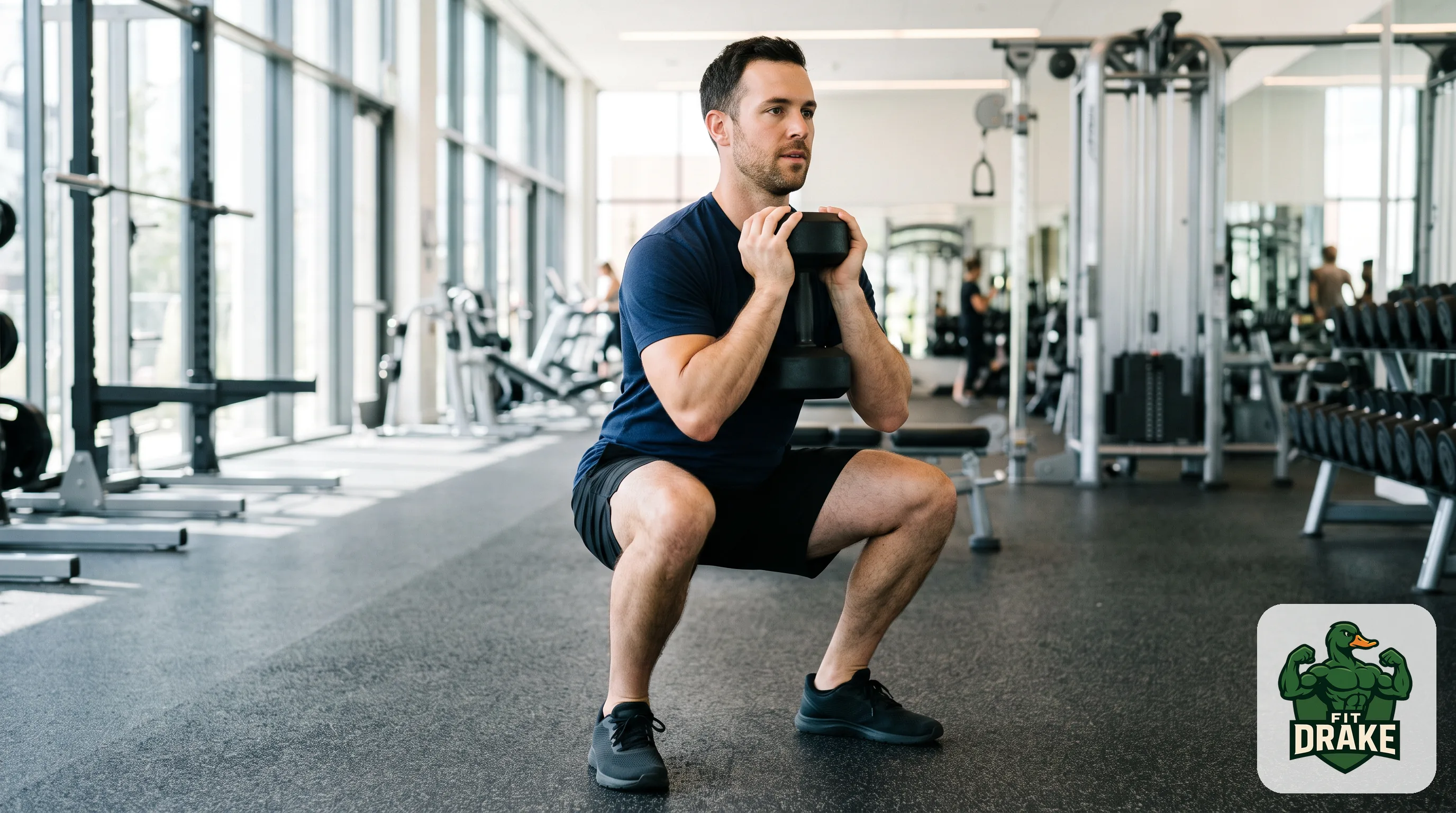
A simple approach is double progression: pick a rep range, add reps until you hit the top of it for every set, then add weight and start again at the bottom. Here's how that could look for a goblet squat with an 8 to 12 rep range:
| Week | Weight | Sets x reps | What changed |
|---|---|---|---|
| 1 | 30 lb | 3 x 8 | Starting point |
| 2 | 30 lb | 3 x 10 | Added reps |
| 3 | 30 lb | 3 x 12 | Top of the range on every set |
| 4 | 35 lb | 3 x 8 | Added weight, back to the bottom of the range |
These numbers are only an example, not a recommendation. Your own starting weight and pace will differ.
To make an AI plan follow this, paste your logged sets back into the chat each week and ask it to set next week's targets using your rule. That works, but it depends on you keeping a log somewhere and remembering to share it. The AI personalization guide explains how an app can do that adjustment from your logs instead.
Can ChatGPT or Claude remember your plan and progress?
Partly. Both assistants have memory features that can carry details between chats, but memory isn't a training log. It may keep your goal and schedule and still lose track of what you lifted three weeks ago. A plan that lives only in a chat also tends to drift: you ask a follow-up, get a slightly different version, and soon you're not sure which one you're following.
There are two practical fixes. The simple one is to keep your plan and your logs in one place you control, such as a notebook, a spreadsheet or a workout log app, and paste the relevant part into the chat when you want advice. The more convenient one is a connector. Both assistants support the Model Context Protocol (MCP), which lets them read from and act in other apps, though write actions depend on your ChatGPT plan. Whether you can add a custom connector depends on the assistant and your plan.
If you'd rather keep a real plan and real logs and still talk to an assistant, the FitDrake connector lets you use your FitDrake plan in ChatGPT and Claude. Once connected, the assistant can show today's workout as a card, open exercise clips, mark a workout day done, and log meals and weigh-ins. The assistant can't rewrite the plan or change your goal. Sign-in uses a one-time code sent to your email, and you can revoke access at any time. Setup steps are on the use your FitDrake plan inside ChatGPT or Claude page.
The plan behind those cards comes from the FitDrake AI workout planner, where the plan is built from your goal, weekly schedule, equipment, training level and any body parts you need to protect, and never prescribes equipment you don't have. With a paid FitDrake plan, when you finish a week, the next one is built from what you actually logged.
What health details should you share with an AI?
Share what changes the plan: your goal, schedule, equipment, experience and any movements that cause pain or that a clinician has told you to avoid. You don't need to paste medical records, test results or medication lists to get a reasonable training plan, and what you share is covered by that assistant's own privacy terms.
If you have a heart, lung or metabolic condition, a recent injury or surgery, are pregnant, or take medication that affects exercise, talk to a doctor or qualified professional before starting a new program. An AI plan is a starting draft, not a medical clearance.
Frequently asked questions
Is ChatGPT or Claude better for workout plans?
Neither is clearly better for everyday plans. Claude 3.7 scored highest in one 2026 study, but that tested older models on synthetic profiles. A detailed prompt and weekly adjustments matter more than which assistant you choose.
What is a good ChatGPT workout plan prompt?
A good prompt states your goal, days per week, session length, equipment, experience, injuries, and the output format you want (sets, reps, rest and RIR), plus a progression rule and a deload. Ending with "ask me any questions first" helps the assistant fill gaps. The template above works for both ChatGPT and Claude.
Can Claude make a workout plan?
Yes. Claude can make a workout plan from the same prompt you'd give ChatGPT. Ask for a table with sets, reps and rest, and ask for swaps for exercises you can't do with your equipment.
Can ChatGPT remember my workout progress?
ChatGPT's Memory can keep some details across chats, but it isn't a reliable workout log. Keep your sets and weights in a log or app, and share them when you want the plan adjusted.
Are AI workout plans safe for beginners?
They can be a reasonable starting point if the plan matches your level, includes rest days and progresses gradually. The assistant can't check your form or health history, so learn new lifts carefully and get medical advice first if you have a condition or injury.
Can I use ChatGPT or Claude for free to make a workout plan?
Both offer free access, and either can draft a plan without a paid plan. Memory, chat search and connector options differ between free and paid plans and change often, so check your own settings.
Want a plan that adjusts to what you actually lift?
If you want a plan that's built from your goal, schedule and equipment, and that you can still talk to in ChatGPT and Claude, download FitDrake on the App Store and start with the free plan. FitDrake is for iPhone, with an Apple Watch app for logging at the gym.
Key takeaways
- ChatGPT and Claude can both draft a solid beginner or intermediate plan; your prompt matters more than the assistant.
- One 2026 study rated Claude 3.7 highest of four models, but it used older models, synthetic profiles and expert ratings, not real outcomes.
- Give the AI your goal, schedule, equipment, experience and limitations, and ask for sets, reps, rest, RIR, a progression rule and a deload.
- Check every AI plan for realistic volume, rest days, progression and exercises that fit your equipment.
- Progress comes from logging what you lift and adjusting each week, which a chat can't do unless you share your log or connect an app.
- Stop any movement that causes pain and see a doctor or physical therapist before continuing.