A budget meal plan for muscle gain is ordinary, low-cost food in the right amounts: about 200 to 300 calories above maintenance and roughly 1.6 to 2.2 grams of protein per kilogram of body weight each day. Build it from eggs, milk, dried beans, lentils, chicken, rice, oats and potatoes, and cook in two batches a week. The 7-day plan below averages about 2,800 calories and 149 grams of protein a day, with a full grocery list and October 2026 US average prices.
Written by FitDrake Team, updated on November 26, 2026
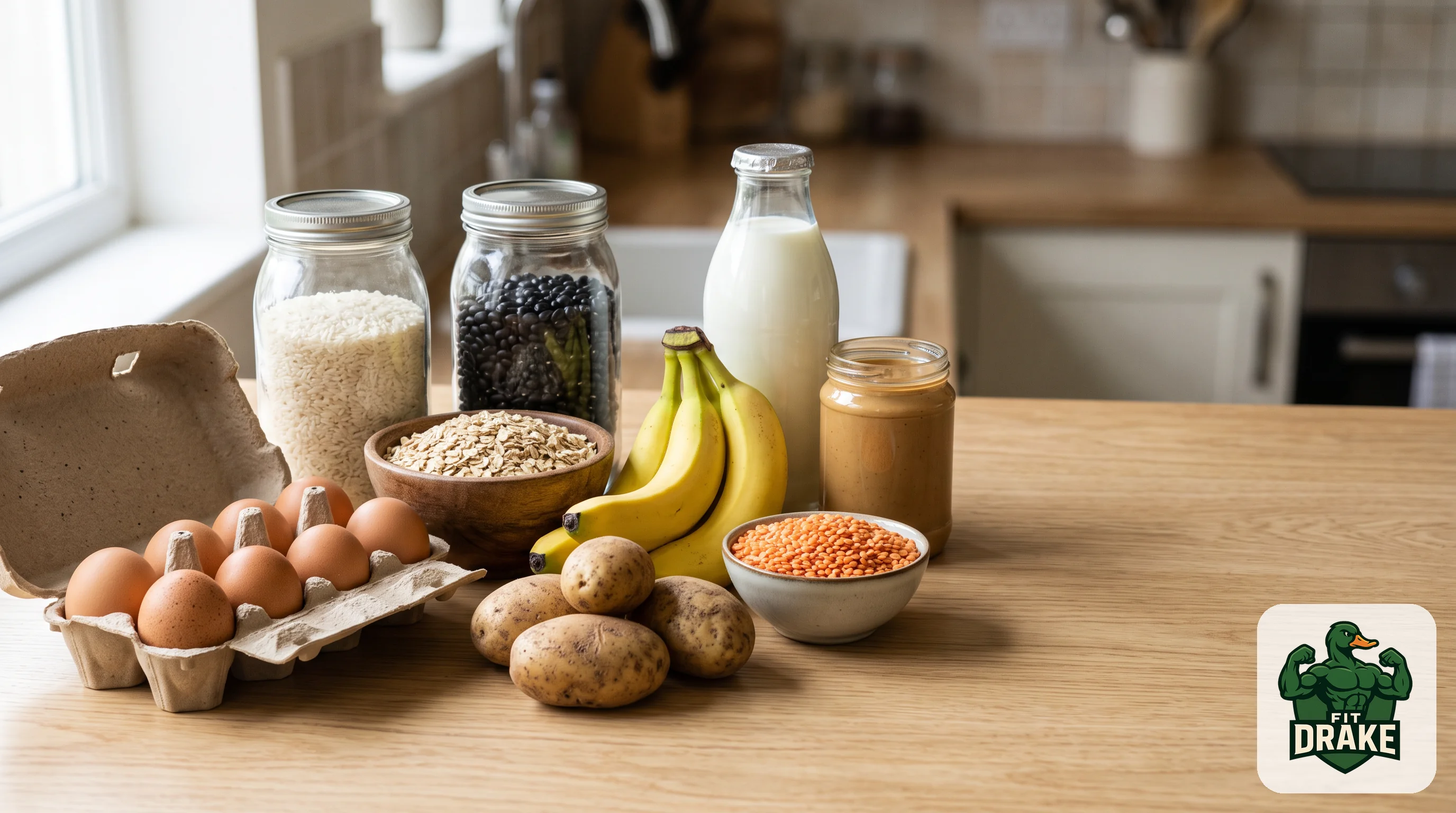
Eating to build muscle has a reputation for being expensive: tubs of protein powder, steak every night, a shopping cart full of chicken breast. You don't need any of that. Muscle growth comes from lifting consistently, eating a little more than you burn, and getting enough protein, and the cheapest foods in the store can cover all of it.
This guide gives you a real 7-day plan instead of one day repeated, with the calories and protein for every day, a grocery list you can screenshot, the cheapest protein sources ranked by cost per 25 grams of protein, and a two-session meal-prep schedule that keeps food safe. You'll also see how to scale the plan for a smaller body, swap in vegetarian meals, and adjust portions when the scale doesn't move.
What does a muscle-gain meal plan on a budget need to do?
It needs to hit two numbers, a modest calorie surplus and enough protein, using foods that cost little per gram of protein and per calorie. Everything else (meal timing, "clean" foods, supplements) matters far less than those two numbers and your training.
That gives you three practical rules:
- Eat a little more than maintenance. A small surplus gives your body the energy to build new tissue without piling on much fat.
- Get enough protein every day. Spread it across three or four meals so each one carries a decent amount.
- Buy calories and protein where they're cheapest. Dried beans, lentils, eggs, milk, rice, oats, pasta and potatoes do most of the work. Meat is there for variety and convenience, not because the plan depends on it.
Food alone won't build muscle, though. It supports the work you do in the gym, which is covered further down.
How many calories and how much protein do you need to gain muscle?
Most people need roughly 200 to 300 calories above their maintenance level and about 1.6 to 2.2 grams of protein per kilogram of body weight per day (about 0.7 to 1 gram per pound). These are general guidelines for healthy adults, not exact prescriptions.
Protein. The International Society of Sports Nutrition position stand on protein and exercise says 1.4 to 2.0 g/kg per day is sufficient for most exercising people who want to build or keep muscle. A 2018 meta-analysis of 49 studies by Morton and colleagues found that extra protein stopped adding lean-mass gains at around 1.6 g/kg per day, and a 2019 review of off-season bodybuilding nutrition by Iraki and colleagues suggests 1.6 to 2.2 g/kg. Aiming for the 1.6 to 2.2 range covers you without overspending on protein your body won't use for muscle.
Calories. Start by estimating your maintenance calories, the amount that keeps your weight steady. Our beginner's guide to macros shows the Mifflin-St Jeor equation step by step. Then add about 200 to 300 calories. The Iraki review suggests aiming to gain about 0.25 to 0.5% of your body weight per week as a novice or intermediate lifter, which is a good way to check whether your surplus is the right size.
Here's how that works for the two example lifters in this guide. These numbers are only an example, not a recommendation, because your own maintenance will differ:
| Lifter A | Lifter B | |
|---|---|---|
| Body weight | 72 kg (159 lb) | 58 kg (128 lb) |
| Height, age, sex | 175 cm, 30, male | 163 cm, 30, female |
| Estimated maintenance (Mifflin-St Jeor x 1.55 for training 3 to 5 days a week) | about 2,600 calories | about 2,000 calories |
| Muscle-gain target (+200 to 300) | 2,800 to 2,900 calories | 2,200 to 2,300 calories |
| Protein (1.6 to 2.2 g/kg) | 115 to 158 g | 93 to 128 g |
| Target gain (0.25 to 0.5% per week) | about 0.4 to 0.8 lb | about 0.3 to 0.6 lb |
The 7-day plan below is built for Lifter A. If you're closer to Lifter B, use the smaller version later in this guide.
If you have kidney disease, diabetes, a history of disordered eating, or any other medical condition, or you're pregnant, check with your doctor or a registered dietitian before you change how much you eat.
What are the cheapest protein sources for muscle gain?
By cost per gram of protein, dried beans and lentils are the cheapest, followed by eggs, milk and pasta, then boneless chicken breast. Ground beef costs roughly five times as much as dried beans for the same protein, which is why the plan uses only a little of it.
The table uses US city average prices from the Bureau of Labor Statistics average retail food price table for October 2026, with protein from USDA FoodData Central. Prices are national averages in US dollars, so your store will be higher or lower.
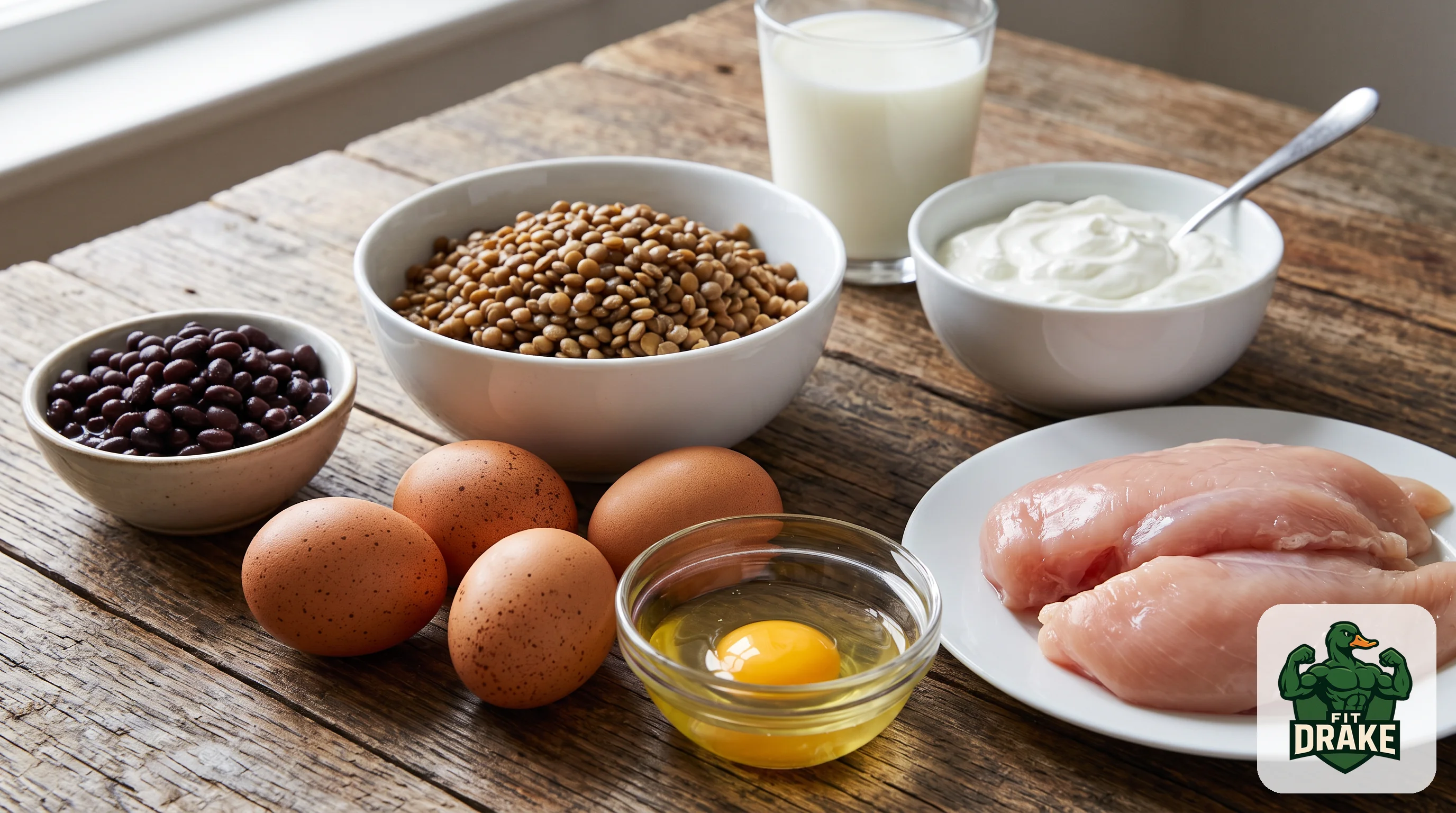
| Food | US average price, Oct 2026 (dollars) | Protein in that amount | Approx. cost per 25 g protein |
|---|---|---|---|
| Dried beans | 1.68 dollars per pound | about 98 g | about 43 cents |
| Pasta (spaghetti, macaroni) | 1.38 dollars per pound | about 59 g | about 58 cents |
| Eggs, large | 2.32 dollars per dozen | about 75 g | about 77 cents |
| Whole milk | 4.10 dollars per gallon | about 123 g | about 83 cents |
| Chicken breast, boneless | 4.10 dollars per pound | about 102 g (raw) | about 1 dollar |
| Cheddar cheese | 6.13 dollars per pound | about 104 g | about 1.48 dollars |
| Ground beef | 6.76 dollars per pound | about 78 g (80/20, raw) | about 2.17 dollars |
Pasta makes the list because a pound has a surprising amount of protein, but it's mostly a carb food, so count it as a bonus rather than your main source. Bone-in chicken legs averaged 1.75 dollars per pound, less than half the boneless breast price, but you pay for bone and skin, so compare them by the cooked meat you actually get.
The BLS doesn't track some of the most useful budget proteins, including lentils, canned tuna, peanut butter, Greek yogurt and tofu. To rank any food yourself, use the shelf tag and the nutrition label:
- Find the package price and the grams of protein per serving.
- Multiply protein per serving by servings per package to get total protein.
- Divide the price by total protein, then multiply by 25.
Run lentils, store-brand canned tuna, peanut butter and large tubs of plain yogurt through those three steps at your own store. Local prices beat anyone's list, including this one.
Which cheap carbs and fats help you hit your calories?
White rice, pasta, oats, potatoes, bread, bananas, peanut butter and cooking oil are the cheapest ways to fill the calorie gap once protein is covered. At October 2026 BLS averages, 500 calories of uncooked white rice cost about 33 cents, pasta about 41 cents, white bread about 77 cents, and potatoes about 1.42 dollars.
Potatoes cost more per calorie but are filling and versatile, so they earn a place on the list. Oats aren't in the BLS table, so price them with the shelf-tag method above; one large canister of rolled oats covers a lot of breakfasts. Peanut butter and oil are calorie-dense, so a spoonful adds a lot of energy for very little money. That's useful when you're struggling to eat enough.
If your appetite is the problem rather than your budget, lean on these foods: a tablespoon of oil in a stir-fry, an extra slice of toast with peanut butter, or a glass of milk with dinner adds calories without making meals much bigger.
What does a 7-day muscle-gain meal plan on a budget look like?
The plan below uses nine meals and four snacks, rotated so you cook in two batches and still eat something different most days. It averages about 2,800 calories and 149 grams of protein a day for Lifter A. The calories and protein are approximate, calculated from the ingredient weights below using USDA FoodData Central values, and the plan is only an example, not a recommendation.
| Day | Breakfast | Lunch | Dinner | Snacks | Approx. calories | Approx. protein |
|---|---|---|---|---|---|---|
| Monday | Peanut butter banana oats | Chicken, rice and bean bowl | Sheet-pan chicken, potatoes and broccoli | Peanut butter toast; milk | 2,885 | 156 g |
| Tuesday | Egg and spinach scramble with toast | Chicken, rice and bean bowl | Beef, lentil and bean chili over rice | Yogurt and banana; milk | 2,740 | 156 g |
| Wednesday | Peanut butter banana oats | Chicken, rice and bean bowl | Beef, lentil and bean chili over rice | Peanut butter toast; yogurt and banana | 2,969 | 151 g |
| Thursday | Yogurt overnight oats | Tuna pasta with peas | Sheet-pan chicken, potatoes and broccoli | Peanut butter toast; milk | 2,697 | 155 g |
| Friday | Egg and spinach scramble with toast | Tuna pasta with peas | Beef, lentil and bean chili over rice | Peanut butter toast; yogurt and banana | 2,755 | 149 g |
| Saturday | Peanut butter banana oats | Egg fried rice | Sheet-pan chicken, potatoes and broccoli | Yogurt and banana; milk | 2,683 | 148 g |
| Sunday | Peanut butter banana oats | Lentil pasta | Egg fried rice | Peanut butter toast; eggs and an apple | 2,820 | 130 g |
What goes into each meal?
Amounts are per serving, with meat weighed raw and grains, beans and lentils weighed dry. A cheap kitchen scale makes this much easier.
| Meal | Ingredients per serving | Approx. calories | Approx. protein |
|---|---|---|---|
| Peanut butter banana oats | 90 g rolled oats cooked in 300 g whole milk (about 1 1/4 cups), 1 banana, 1 tablespoon peanut butter | 727 | 26 g |
| Egg and spinach scramble with toast | 3 eggs, 80 g frozen spinach, 1 teaspoon oil, 3 slices whole-wheat toast, 1 banana | 631 | 35 g |
| Yogurt overnight oats | 90 g rolled oats, 170 g plain nonfat Greek yogurt, 200 g whole milk, 1 apple | 657 | 36 g |
| Chicken, rice and bean bowl | 150 g chicken breast, 100 g rice, 45 g dried black beans (cooked), 100 g frozen mixed vegetables, 60 g salsa, 1 1/2 teaspoons oil | 850 | 55 g |
| Tuna pasta with peas | 120 g drained canned light tuna in water, 120 g pasta, 100 g frozen peas, about 1 tablespoon oil | 731 | 44 g |
| Sheet-pan chicken, potatoes and broccoli | 150 g chicken breast, 500 g potatoes, 150 g frozen broccoli, 1 tablespoon oil | 737 | 48 g |
| Beef, lentil and bean chili over rice | 70 g 80/20 ground beef, 40 g dried lentils, 30 g dried black beans, 50 g onion, 120 g canned tomatoes, 90 g rice, 1 teaspoon oil | 833 | 36 g |
| Egg fried rice | 85 g rice, 3 eggs, 60 g chicken breast, 150 g frozen mixed vegetables, 2 teaspoons oil | 793 | 43 g |
| Lentil pasta | 60 g dried lentils, 90 g pasta, 150 g canned tomatoes, 20 g cheddar, 1 1/2 teaspoons oil | 712 | 32 g |
| Peanut butter toast | 2 slices whole-wheat bread, 2 tablespoons peanut butter | 353 | 15 g |
| Yogurt and banana | 170 g plain nonfat Greek yogurt, 1 banana | 207 | 19 g |
| Milk | 360 g whole milk (about 1 1/2 cups) | 220 | 11 g |
| Eggs and an apple | 2 hard-boiled eggs, 1 apple | 237 | 13 g |
Season with whatever you already have: chili powder, cumin, garlic, soy sauce, salt and pepper. Seasonings aren't counted in the numbers, and they barely change them.
What should be on your grocery list for the week?
Here's everything the 7-day plan uses. The amounts are what you'll eat, so round up to the nearest package size and keep the extra for next week.
Protein and dairy
- Boneless chicken breast: about 1 kg (2 1/4 lb)
- Ground beef, 80/20: 210 g (buy a 1-lb pack and freeze the rest)
- Large eggs: 14
- Canned light tuna in water: enough for 240 g drained (usually 2 to 3 small cans)
- Plain nonfat Greek yogurt: 850 g (a 32-ounce tub)
- Whole milk: about 2.8 liters (a little under 3 quarts; buy a gallon jug and keep the rest)
- Cheddar cheese: 20 g
- Dried black beans: 225 g
- Dried lentils: 180 g
Carbs
- White rice: 740 g
- Rolled oats: 450 g
- Pasta: 330 g
- Whole-wheat sandwich bread: 16 slices (one loaf)
- Potatoes: 1.5 kg (about 3 1/3 lb)
- Bananas: 10
- Apples: 2
Vegetables and extras
- Frozen mixed vegetables: 600 g
- Frozen broccoli: 450 g
- Frozen chopped spinach: 160 g
- Frozen peas: 200 g
- Canned tomatoes: 510 g
- Salsa: 180 g
- Onion: 1 large
- Peanut butter: 224 g
- Canola or other vegetable oil: about 140 g (roughly 2/3 cup)
What it costs. At October 2026 BLS averages, the chicken, beef, eggs, milk, rice, dried beans, pasta, bread, potatoes and cheese in the amounts above come to about 27 dollars (bread is priced with the white-bread average because BLS doesn't publish a whole-wheat price). Oats, lentils, tuna, yogurt, peanut butter, frozen vegetables, tomatoes, salsa, fruit, onion and oil aren't in the BLS table, so add your own store's prices for those. For a sense of scale, the USDA Thrifty Food Plan, the government's lowest-cost healthy diet benchmark, was 73.70 dollars a week for a man aged 20 to 50 and 58.70 dollars for a woman of the same age in October 2026 (for one person in a four-person household; USDA suggests adding 20% if you live alone).
Five habits keep the total down:
- Compare store brands of oats, rice, pasta, canned tomatoes, peanut butter and yogurt by the unit price on the shelf tag. They're often the cheaper option for the same basic food.
- Use frozen vegetables. They're already washed and chopped, keep for weeks, and you only cook what you need.
- Buy staples in bulk when the larger bag costs less per pound. Rice, oats and dried beans store well in a sealed container.
- Cook dried beans. They were the cheapest protein in the BLS table. Soak them overnight, then simmer until tender.
- Build the week around what's on sale. If pork chops or chicken thighs are cheaper than breast this week, swap them in.
How do you meal prep this plan in two sessions?
Cook twice a week, on Sunday and Wednesday, so nothing sits in the fridge longer than 3 to 4 days. The USDA Food Safety and Inspection Service guidance on leftovers says to refrigerate cooked food within 2 hours, eat refrigerated leftovers within 3 to 4 days, and freeze anything you won't eat by then.
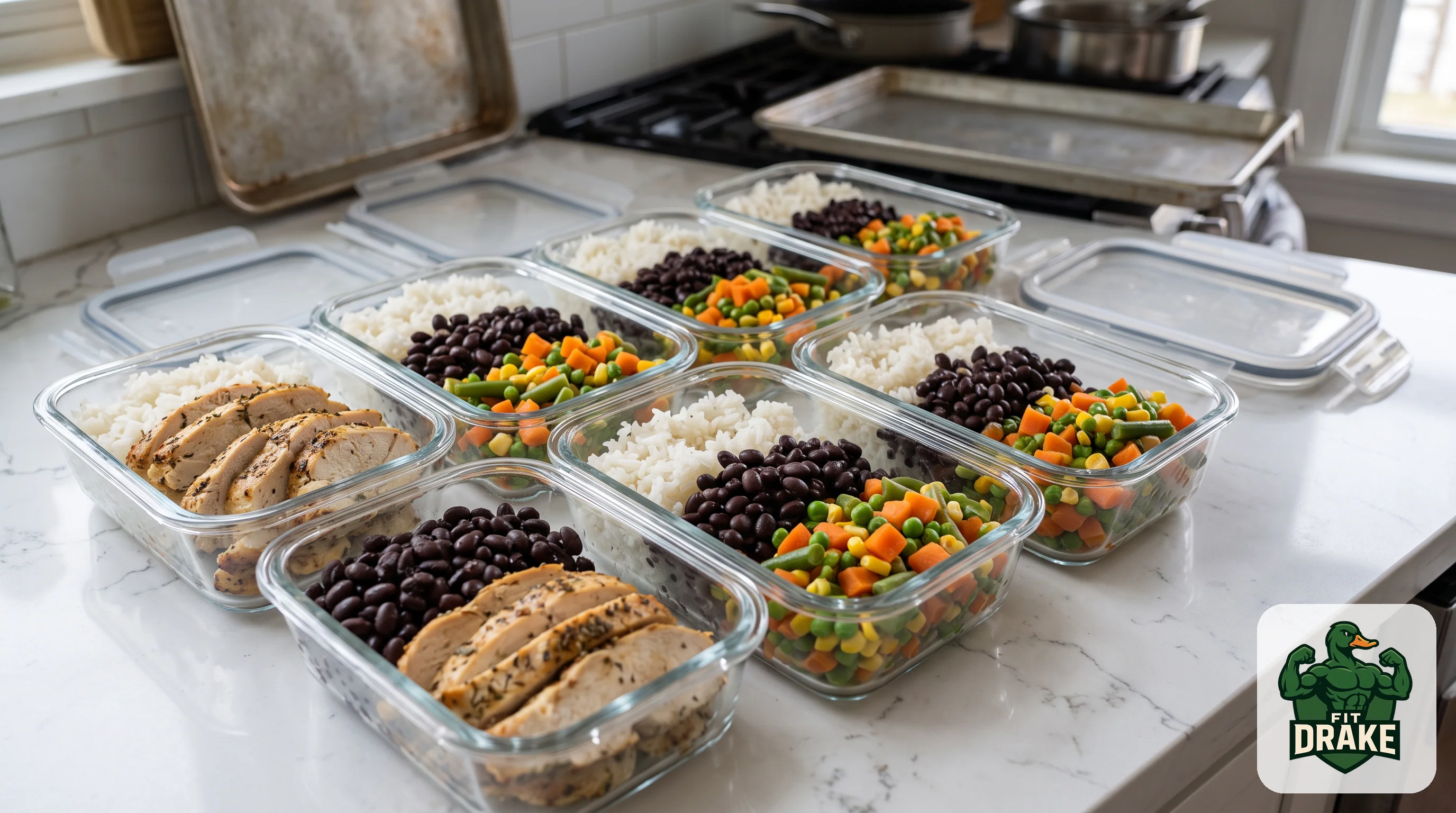
Sunday session (covers Monday to Wednesday, plus Friday's chili):
- Soak the dried black beans the night before, then simmer them until tender.
- Bake 600 g of chicken breast for three chicken bowls and Monday's sheet-pan dinner. Roast Monday's potatoes and broccoli on the same pan.
- Cook 570 g of dry rice: three portions for the bowls and three for the chili dinners.
- Make the beef, lentil and bean chili (three portions). Use the rest of the cooked beans for the bowls.
- Portion everything into containers. Put Tuesday's and Wednesday's chili in the fridge and Friday's in the freezer, with its rice.
Wednesday session (covers Thursday to Saturday):
- Bake 420 g of chicken breast: two sheet-pan dinners (Thursday and Saturday) plus 120 g to chop for the weekend fried rice.
- Roast the potatoes and broccoli for those two dinners.
- Cook the tuna pasta with peas for Thursday and Friday lunch.
- Move Friday's chili from the freezer to the fridge on Thursday night so it thaws safely.
Saturday and Sunday: cook a fresh pot of rice on Saturday and make both portions of egg fried rice, one for Saturday lunch and one for Sunday dinner. Make the lentil pasta fresh on Sunday, which is also your prep day for the next week. Hard-boil a few eggs whenever the stove is on.
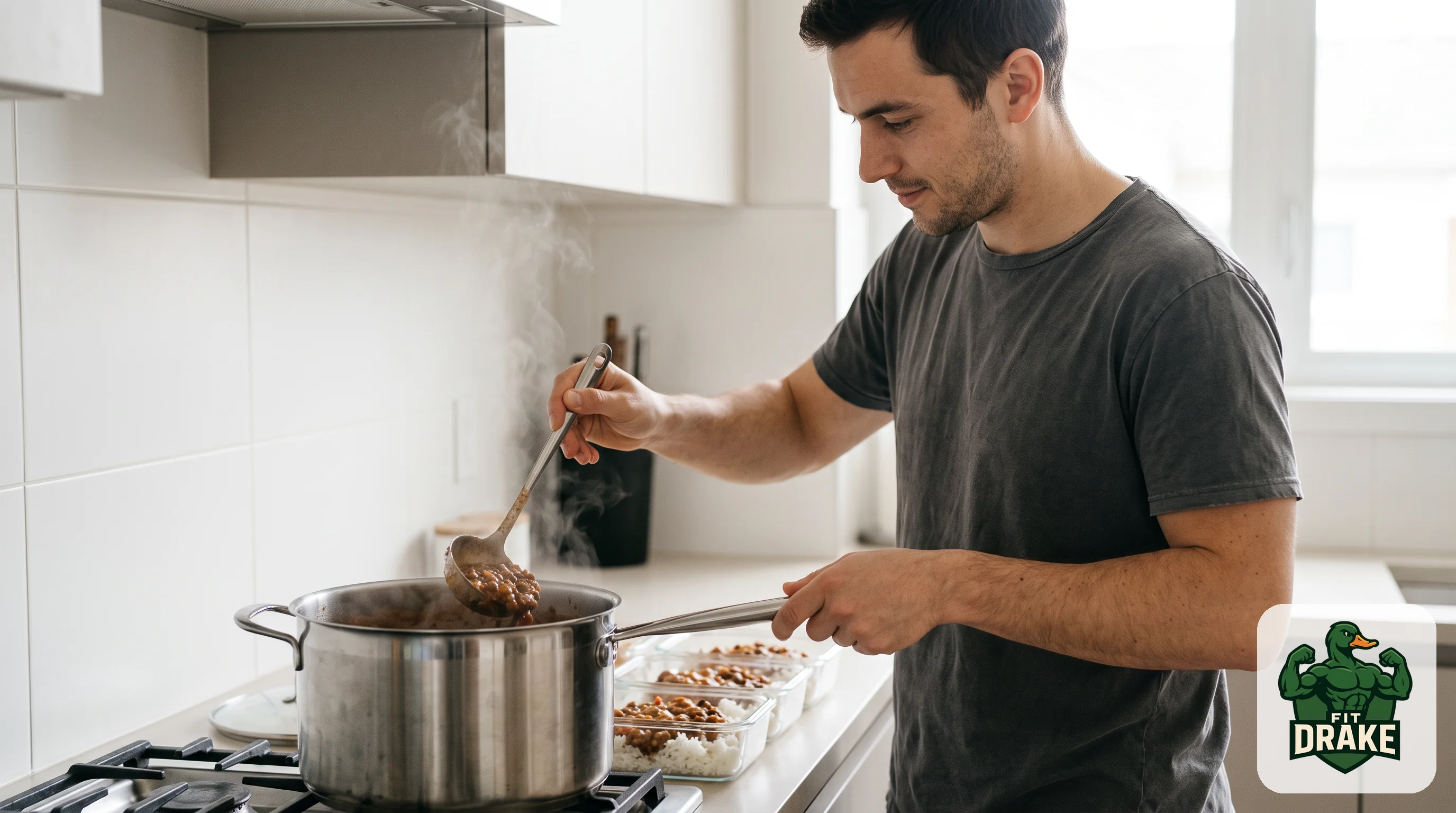
A few safety basics from the same FSIS page: cook chicken to 165°F and ground beef to 160°F, cool big batches quickly by splitting them into shallow containers, and reheat leftovers to 165°F. Frozen leftovers stay safe, but FSIS suggests eating them within 3 to 4 months for the best quality.
How do you swap meals without breaking the budget?
Swap like for like: one protein for another protein, one carb for another carb, and keep the amounts close. That keeps the day's calories and protein in the same range without redoing the math.
| Instead of | Try | Why it works |
|---|---|---|
| Chicken breast | Chicken legs or thighs | Bone-in legs averaged less than half the boneless breast price per pound in October 2026; weigh the cooked meat |
| Canned tuna | 4 eggs, or extra beans | Similar protein for the meal |
| Ground beef in the chili | More lentils and beans | Cheaper protein per gram |
| Rice | Pasta, or potatoes | Pasta is close to rice per calorie; potatoes cost more but are filling |
| Greek yogurt | Cottage cheese | Similar protein per gram |
| Whole milk | Soy milk | Dairy-free, with similar protein per cup |
Vegetarian version. If you eat eggs and dairy, replace the chicken in the rice bowl with 150 g of firm tofu (about 831 calories and 46 g of protein), and have the lentil pasta in place of the chili. A full vegetarian day of peanut butter oats, the tofu bowl, lentil pasta, peanut butter toast, and yogurt with a banana comes to about 2,830 calories and 138 g of protein. Eggs and Greek yogurt do a lot of work here, so a fully vegan plan needs more tofu, beans and lentils to make up the protein.
Allergies. Peanuts, milk, eggs, fish, soy and wheat all appear in this plan. Check every label if you have an allergy, and swap the affected food for one from the table above.
If you'd rather not work out swaps yourself, meal plans in a paid FitDrake plan are built around your answers: setup asks about allergies and foods you dislike, and each meal slot has alternatives you can switch to. Always check ingredients yourself if you have an allergy; FitDrake is general nutrition information, not medical advice.
How do you scale the plan for a smaller body or appetite?
Shrink the carbs and fats first and keep most of the protein. For Lifter B (58 kg, about 2,200 to 2,300 calories), one way to trim Monday looks like this:
- Peanut butter banana oats with 60 g oats and 250 g milk (about 582 calories, 21 g protein)
- Chicken, rice and bean bowl with 120 g chicken and 60 g rice (about 668 calories, 45 g protein)
- Sheet-pan dinner with 120 g chicken, 350 g potatoes and 2 teaspoons oil (about 541 calories, 38 g protein)
- Peanut butter toast, plus a banana in place of the glass of milk
That day comes to about 2,250 calories and 121 g of protein, inside Lifter B's targets. Apply the same idea to the other days: cut the rice, pasta, oats or potatoes by about a third and drop one snack. It's also a sensible starting point for many women, since the principles are the same and only the portions change.
How do you adjust portions if the scale isn't moving?
Weigh yourself a few mornings a week, after the bathroom and before eating, and compare weekly averages rather than single days. Then adjust in small steps:
- Not gaining after two weeks: add about 200 calories a day, the step our macros guide suggests. An extra 50 g of dry rice (about 180 calories) or a glass of milk (about 220 calories) both work.
- Gaining faster than about 0.5% of body weight a week for two weeks in a row: remove a similar amount, starting with oil or one snack.
- Gaining at the target rate and your lifts are going up: change nothing.
Body weight jumps around from day to day with water, salt and food in your stomach, so give each change two weeks before you judge it.
How do you make your own muscle-gain meal plan on a budget?
Use this plan as a template. You only need your own targets and a list of foods you'll actually eat.
- Set your targets. Estimate maintenance calories, add 200 to 300, and set protein at 1.6 to 2.2 g/kg.
- Pick three or four cheap proteins from the cost table, plus one or two you enjoy.
- Pick two or three carbs (rice, oats, pasta, potatoes, bread) and one or two fats (peanut butter, oil).
- Build five or six meals you like and repeat them across the week, as in the plan above. Aim for at least 20 to 40 g of protein in each main meal, the per-serving range the ISSN position stand gives.
- Shop from one list and cook in two sessions, then check the scale weekly and adjust.
If you'd rather not do the math, the AI meal planner in a paid FitDrake plan calculates your calorie targets with the Mifflin-St Jeor equation and plans breakfast, lunch, dinner and a snack around your calorie and protein targets. Calories come from weighed ingredients, checked against USDA, and meal plans are part of a paid FitDrake plan.
Why does training matter as much as the food?
Food gives your body the materials and energy, but lifting is the signal to build muscle. Without it, a calorie surplus mostly adds fat. The ISSN position stand describes resistance exercise and protein as working together to stimulate muscle protein synthesis.
Train each major muscle group a couple of times a week and add a little weight or a rep over time, a principle called progressive overload. If you're starting from scratch, FitDrake's AI workout planner builds your plan (exercises, sets, reps and rest) from your goal and the equipment you have.
Frequently asked questions
How can I build muscle on a tight budget?
Lift consistently, eat about 200 to 300 calories above maintenance, and get most of your protein from dried beans, lentils, eggs, milk and chicken. Cook in batches and repeat a handful of meals so nothing goes to waste.
What is the cheapest protein for muscle gain?
At October 2026 US average prices, dried beans were the cheapest at about 43 cents per 25 g of protein, followed by pasta, eggs and milk. Lentils aren't in the BLS data, so check their unit price at your own store.
Do I need protein powder to build muscle?
No. The ISSN position stand notes that active people can meet their protein needs from whole foods, and this plan reaches about 149 g a day without any powder. Protein powder can be convenient, so compare it by cost per 25 g of protein like any other food.
How much protein do I need to build muscle?
About 1.6 to 2.2 g per kilogram of body weight per day (0.7 to 1 g per pound) works for most lifters. For a 72 kg (159 lb) person, that's roughly 115 to 158 g a day.
Can I build muscle on a vegetarian budget?
Yes. Beans, lentils, tofu, eggs, milk and Greek yogurt are some of the cheapest proteins there are. Replace the chicken and beef with tofu and extra lentils, and keep the eggs and dairy if you eat them.
Is there a different meal plan for muscle gain for women?
No. The same rules apply: a small surplus, 1.6 to 2.2 g of protein per kg, and progressive training. Most women will need smaller portions, so start from the Lifter B version and adjust from your weekly weigh-ins.
How do I make my own meal plan for muscle gain?
Set your calorie and protein targets, choose a few cheap proteins and carbs you like, build five or six meals, and repeat them across the week. Weigh yourself weekly and change portions in small steps.
Want your workouts and meals planned for you?
Get FitDrake on the App Store and start with the free plan. Free to start: one goal, one AI workout plan, and weight and measurement tracking. Meal plans are a paid FitDrake plan feature: the app plans breakfast, lunch, dinner and a snack around your calorie and protein targets. FitDrake is for iPhone, with an Apple Watch app.
Key takeaways
- A budget muscle-gain plan needs a small surplus (about 200 to 300 calories) and 1.6 to 2.2 g of protein per kg of body weight a day.
- Dried beans, lentils, eggs, milk, rice, oats, pasta and potatoes give you the most protein and calories for your money.
- The 7-day plan averages about 2,800 calories and 149 g of protein, and the BLS-tracked staples cost about 27 dollars at October 2026 averages.
- Cook in two sessions a week and eat refrigerated leftovers within 3 to 4 days.
- Scale portions to your own targets, judge progress by two-week weight averages, and adjust in small steps.
- Food supports muscle growth only when you pair it with progressive strength training.